
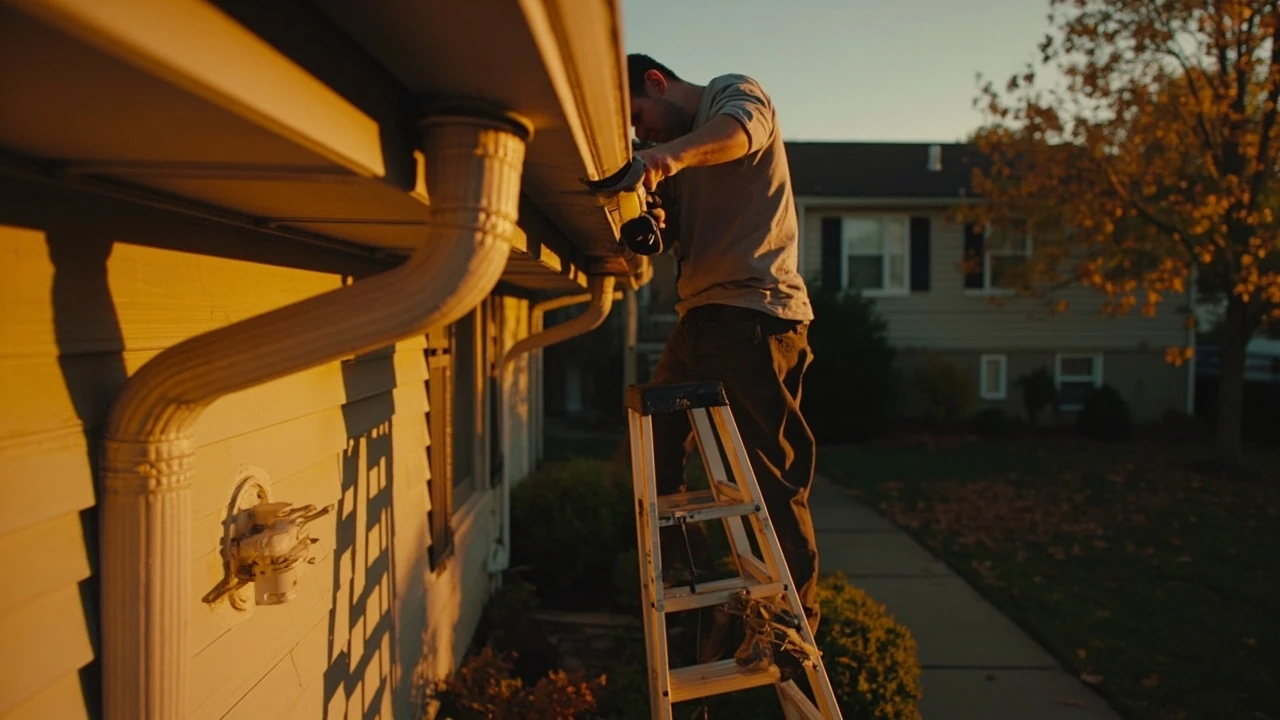
Rain gutter repair: what it really covers and when it makes sense
A streak of dirt on a fascia board, a puddle that keeps returning beneath a downspout, a small plant taking root near a corner mitre — these are the early signals that drive most homeowners toward rain gutter repair. The work itself is rarely glamorous, but the decisions that surround it matter: repair the section that is failing, or replace the whole run because the system has reached the end of its useful life. The right answer depends on the material, the age, the type of damage, and how the gutters were originally installed.
This guide walks through how to evaluate a gutter system, what a realistic repair scope looks like, and when the smarter move is to stop patching and start over. It is written for a homeowner trying to make a clear-headed call, not for a contractor defending a quote.
How to tell a gutter actually needs repair
Not every gutter problem is a repair problem. Some symptoms point to a localized failure that a small fix will resolve. Others are early signs that the entire system is at the end of its service life. The first job is sorting one from the other.
Use water, not just your eyes, to confirm a suspected failure. A dry inspection can miss slow leaks, and a wet inspection can reveal where water is actually escaping versus where staining suggests it once did. A garden hose set to a gentle flow at the far end of a run is enough for most homes; a heavier stream is useful when checking downspout capacity during a realistic storm.
Visible signs worth taking seriously
- Water marks or tiger striping on the face of the gutter, which usually means the gutter has been overflowing regularly rather than just once.
- Peeling paint or rust blooms on metal gutters, especially near end caps, mitres, and outlet tubes.
- Sections that visibly sag between brackets, or a tilt that no longer points toward the downspout.
- Seams that have separated, leaving a dark line where two sections used to meet tightly.
- Soil erosion, mulch displacement, or a dead strip of lawn directly beneath an outlet.
- Stains or mildew on the soffit or fascia behind the gutter, which usually means water has been getting behind the trough.
- Icicles forming in uneven patterns along the eave in winter, a sign of localized overflow or poor slope.
What a simple water test reveals
Block the downspout with a rag, run water into the gutter from a hose at the high end of the run, and watch what happens at the low end. The water level should rise slowly, the gutter should sit flat without bowing outward, and the end caps should stay dry. Release the rag and watch the downspout: the surge should be steady, not a slow trickle, and the water should clear completely within a minute or two after the hose is shut off. Standing water that remains in the trough after the test is a slope problem, not a leak problem, and it changes the type of repair you need.
Common rain gutter problems and what causes them
Most rain gutter repair calls fall into a familiar set of failure modes. Each has a typical cause, a typical lifespan impact, and a typical fix. Treating them as a single problem is how homeowners end up paying for the same visit twice.
Sagging runs
Sagging is usually a fastener or hanger problem, not a gutter problem. The trough itself is often fine; the brackets, spikes, or hidden hangers have failed. Spike-and-ferrule systems installed on older homes are particularly prone to this because the spike works loose from the fascia over time. The repair is usually re-hanging the affected section with new hangers spaced closer together, not replacing the metal.
Leaks at seams, mitres, and end caps
Seam leaks are the classic rain gutter repair. On sectional systems, every joint is a future leak waiting for the sealant to age out. The fix is a combination of mechanical repair — reseating the joint, closing a small gap — and a flexible gutter sealant rated for the material. On seamless systems, leaks at mitres and end caps are usually a sealant failure rather than a material failure, and a careful reseal often solves them.
Improper slope
Slope problems are easy to misdiagnose as clog problems. If water stands in a section after rain and the downspout is clear, the run has lost its fall. Gutters need roughly a quarter inch of slope per ten feet toward the downspout. When fascia boards have shifted or hangers were installed too high, the trough no longer drains. Re-hanging the run to restore slope is a more involved repair than resealing, but it is the only real cure.
Loose or detached downspouts
Downspouts work loose because the straps rust, the screws pull out of soft siding, or the lower elbow takes a hit from a lawnmower or a kid’s bike. Replacing straps and securing the lower elbow is straightforward. Persistent detachment usually points to a downspout that is too long for the wall, with too much weight on the bottom strap.
Pin holes and rust through
On galvanized or painted steel gutters, rust through the bottom of the trough is a terminal diagnosis. Patch compounds buy a season or two, but the metal around the patch is usually thinning too. Aluminum does not rust, but it can pit badly enough to leak, especially near end caps and outlet tubes. Copper and zinc develop a protective patina and rarely need this kind of repair.
Damage from ice and ladders
Two common but unrelated causes of rain gutter repair are ice dams and ladder dents. Ice dams push water back under the shingle line and into the trough, and the freeze-thaw cycle can deform hangers. Ladder dents crease aluminum and crack older vinyl. Either problem is local in scope, but if the dent is severe enough to trap water, the affected section should be replaced rather than straightened.
Repair versus replacement: a decision framework
The hardest call in any gutter project is when to stop repairing and replace the run. The decision is not really about the gutter itself; it is about how many more repair visits the system can absorb before the labor cost exceeds the cost of new material.
| Situation | Likely better choice | Why |
|---|---|---|
| One or two leaking seams on an otherwise sound sectional system | Repair | Resealing localized joints is cheap and the rest of the run is still in service. |
| Sagging between widely spaced spikes on an older spike-and-ferrule system | Repair, with caveat | Re-hanging works short term, but the system may need full replacement within a few years. |
| Pin holes or rust on the bottom of a steel trough | Replace | Patches around rust rarely last, and the metal is thinning everywhere. |
| Widespread tiger striping and multiple seam failures | Replace | Each new leak appears faster than the last; cumulative cost exceeds replacement. |
| Slope failure on a seamless aluminum run | Repair, with evaluation | Re-hanging can restore fall if the fascia is sound; replacement only if the wood behind it has softened. |
| Vinyl gutters cracked at multiple hanger points | Replace | Vinyl becomes brittle with age; once it cracks, more cracks will follow. |
| Single dent from a ladder on otherwise straight aluminum | Repair | One dent rarely affects drainage if the slope is still correct. |
| System more than 25 years old with recurring problems | Replace | Expected service life for most residential systems is in the 20 to 30 year range. |
The framework behind the table is simple. A repair makes sense when the failure is local, the surrounding material is healthy, and the underlying cause has been addressed. A replacement makes sense when the failure is part of a pattern and the next failure is a question of when, not if.
What a realistic rain gutter repair visit looks like
Knowing what a repair visit should include helps you judge whether a quote is reasonable. A good visit is structured, not improvised in your driveway.
Typical scope of a service call
- Walk the perimeter and identify every visible defect: sags, stains, separations, rust, missing hangers, and disconnected downspouts.
- Flush each run with water to confirm slope and check for standing water after the test.
- Clear debris from troughs and outlets before any sealing or re-hanging, because sealing over debris is the most common cause of a callback.
- Re-hang sagging sections with new hangers, or replace failed spikes with screw-in hangers for a more secure hold.
- Reseal leaking seams, mitres, and end caps after the joint is mechanically tight, using a sealant rated for the gutter material.
- Resecure downspout straps, replace any that have rusted through, and reattach loose elbows.
- Confirm slope toward each outlet by eye and by a final water test, and adjust hangers as needed.
A single-story home with a straightforward layout and one or two localized defects is often completed in two to four hours. Multi-story homes, heavy debris, and a system that has been neglected for several seasons push the visit toward a full day.
Materials, sealants, and fasteners: matching the fix to the system
Rain gutter repair fails more often from mismatched materials than from poor technique. Aluminum, galvanized steel, copper, zinc, and vinyl each have their own preferred sealants, fasteners, and patch compounds. The supplier’s recommendation is more useful than the brand on the shelf.
| Material | Typical life in residential use | Repair-friendly? | Notes for repair work |
|---|---|---|---|
| Aluminum (seamless) | 25 to 30 years | Yes, for seams and hangers | Patches and sealants bond well; use aluminum-compatible fasteners to avoid galvanic reaction. |
| Galvanized steel | 15 to 25 years | Limited once rust appears | Coat any cut edges with cold galvanizing compound to slow rust return. |
| Copper | 50+ years | Rarely needed | Use copper-compatible fasteners; never mix with steel or aluminum hardware. |
| Zinc | 40+ years | Rarely needed | Soldering is the traditional repair method; modern sealants are acceptable for small joints. |
| Vinyl (PVC) | 10 to 20 years | Limited | Brittle with age; replace cracked sections rather than patching. |
| Cast iron (heritage homes) | 40+ years | Specialist work | Often better left to a contractor experienced with the material and matching profiles. |
For fasteners, screw-in hidden hangers have largely replaced the older spike-and-ferrule approach because they hold better and are easier to remove if a section needs to come down. Stainless or coated screws resist corrosion far longer than the original spikes, and a closer hanger spacing — roughly every 24 inches rather than 36 — is a worthwhile upgrade during a repair visit.
When the problem is not the gutter at all
Some of the most expensive rain gutter repair mistakes start with the wrong diagnosis. A few look-alike problems are worth understanding before you sign off on a work order.
Roof edge and drip edge issues
Water that streaks behind the gutter often points to missing or short drip edge flashing along the roof line, not a gutter failure. The drip edge should extend into the gutter trough. If it stops short, water tracks behind the gutter and rots the fascia. The fix is a roofer’s job, not a gutter tech’s, even though the symptom looks the same from the ground.
Fascia and soffit rot
If the gutter pulls away from the house under its own weight, the fascia behind it is often soft. Re-hanging a gutter into rotted wood is a short-lived repair. The right order is to replace the fascia, then re-hang or replace the gutter. Skipping the woodwork turns a clean repair into a recurring callback.
Foundation grading and underground drainage
Water pooling at the base of a downspout is sometimes a grading problem, not a gutter problem. The gutter may be doing its job and discharging exactly where it was always going to discharge. Extending the downspout, adding a splash block, or tying the downspout into an underground drain can resolve the symptom without touching the trough at all.
Roof runoff patterns
Concentrated flow from a valley above a short gutter run can overwhelm the system. A typical example is a steep valley above a small section of eave over a porch. The right answer is sometimes a larger outlet or a second downspout on that run, not a repair of the trough itself.
How to think about cost without getting lost in quotes
Gutter pricing is regional and material-driven, so a national number is rarely useful. What is useful is a clear sense of the components of a quote and the questions that reveal whether the work is priced for a real repair or for a partial replacement dressed up as a repair.
Questions worth asking before authorizing work
- Is the quote for a specific repair, or is it a stop-gap until full replacement?
- What is included in cleanup, and is haul-away of old material in the price?
- Are new hangers spaced closer than the existing ones, or are old hangers being reused?
- What sealant is being used, and is it compatible with the gutter material?
- Is the fascia behind the gutter being inspected, and what happens if it is found to be soft?
- How is the work warrantied, and what does the warranty cover if a seam fails six months later?
A repair quote that is vague about scope is often a quote that grows once the technician is on the ladder. A clear scope keeps the visit to a single, predictable cost.
DIY rain gutter repair: when it is sensible and when it is not
A surprising amount of routine gutter work is well within the range of a careful homeowner with a stable ladder, a hose, and a few hand tools. Some work is not, and the line between the two is mostly about height, material, and the type of failure.
Tasks a homeowner can usually handle
- Cleaning troughs and outlets by hand and with a hose.
- Resealing a single leaking mitre or end cap on a one-story home.
- Replacing a damaged downspout section or a missing strap on a single-story wall.
- Re-hanging a short sagging section if the fascia behind it is solid.
- Adjusting hanger screws to restore slope on a small run.
Tasks that are usually better left to a pro
- Any work above a single story, especially on a steep roof or over a deck.
- Replacement of long seamless runs, which require a roll-forming machine on site.
- Soldering on copper or zinc systems.
- Repairs that require removing and resetting a section of roofing, including drip edge work.
- Anything that involves suspected rotted fascia, because the repair changes once the wood is opened up.
The strongest reason to call a professional is not the technical skill; it is the ladder. A high percentage of gutter-related injuries are falls from ladders set on uneven ground. If the work is on a one-story ranch with a level yard and a stable ladder, a homeowner can usually manage. If the eave is over a sloped lawn, a second story, or a hard surface, the safer call is to bring in someone whose full-time job is working on a ladder.
Preventive maintenance that reduces future repair calls
Gutters are not maintenance-free, but the amount of attention they need is modest. A twice-yearly rhythm is enough for most homes, with a third visit useful in areas with heavy tree cover or recurring ice.
A practical maintenance routine
- In late spring, clear the system of seed pods, flowers, and any debris the spring pollen cycle dropped into the troughs.
- In late fall, clear leaves and check slope after the first heavy leaf drop, then again after the last leaf drop of the season.
- Run water through every run after each cleaning to confirm slope and downspout flow.
- Walk the perimeter after the first significant storm of the season and look for new stains, sags, or overflow marks.
- Re-seal any joint that has weeped even slightly, rather than waiting for a full drip to appear.
Gutter guards change the maintenance pattern rather than eliminating it. They reduce the volume of debris that reaches the trough, but most still need occasional brushing and a periodic check at the outlets where fine debris accumulates. The decision to add guards is reasonable for homes under heavy tree cover, but it should be evaluated on its own merits rather than treated as a substitute for a full rain gutter repair when one is genuinely needed.
Frequently asked questions
How long should a residential gutter system last before rain gutter repair stops making sense?
Most residential systems have a service life in the 20 to 30 year range, depending on material. Aluminum and copper last longer, vinyl and galvanized steel shorter. When a system is past two-thirds of its expected life and showing multiple failures, the cost of repeated repairs usually exceeds the cost of a one-time replacement.
Can rain gutter repair be done in cold weather?
Sealants have temperature ranges, and most cure poorly below freezing. Mechanical repairs like re-hanging a sagging section can be done year-round, but sealing work is more reliable in mild, dry conditions. If a leak cannot wait, a temporary patch with roofing tape or a self-adhesive flashing can bridge the gap until a permanent fix in better weather.
Is a leak at a mitre always a sealant problem?
Usually, but not always. A mitre that has shifted because the fascia has moved, or because a rafter tail has sagged, will keep opening up no matter how often it is sealed. If a mitre keeps failing after a clean reseal, the issue is likely behind the gutter rather than in it, and the fascia and rafter tail should be inspected before another repair is attempted.
Are gutter repairs covered by homeowners insurance?
Insurance typically covers sudden, accidental damage such as a tree falling on a gutter, but not gradual deterioration, neglect, or wear. Damage from a named storm is often covered, while the slow sag of an old spike-and-ferrule system is not. The specific wording of the policy and the cause of the damage are what determine coverage, not the repair itself.
How do I know whether a stain on my siding is a gutter problem or a roof problem?
Look at the location and the shape of the stain. A stain that lines up with a gutter joint or outlet is almost always a gutter failure. A stain that follows a roof line, runs down from a shingle course, or appears above the gutter trough is more often a roof flashing or drip edge issue. The two problems need different contractors, and a good rain gutter repair visit should distinguish between them before any work is done.
What is the difference between a sectional and a seamless gutter, and does it matter for repair?
Sectional gutters are joined from short pieces, so every joint is a potential leak. Seamless gutters are formed on site from a single coil, so the only joints are at mitres, end caps, and outlets. For repair, seamless systems tend to need fewer seam fixes over their life. When a seamless trough itself is damaged, the affected run usually has to be replaced rather than patched, because the section was formed to length on the original visit.
Can a rain gutter repair fix an ice dam problem?
Not directly. Ice dams are usually a roof insulation and ventilation issue, not a gutter issue. A correctly sloped, clear gutter can help by moving water away before it freezes, but if heat is escaping through the roof and melting snow unevenly, the fix is in the attic, not on the eave. Gutter heating cables can reduce the symptom, but they do not address the cause.
How often should downspouts be checked even if the gutters look fine?
At least twice a year, ideally as part of the same spring and fall routine. Downspouts clog at the elbow and at the underground tie-in, neither of which is visible from the ground. A quick flush from the top tells you whether the system is moving water as designed, and it usually takes less than a minute per downspout.
Is it worth repairing a single dented section of aluminum gutter?
If the dent is above the water line and the slope is correct, yes — a dent rarely affects drainage. If the dent is below the water line and creates a low spot that holds water, the section should be replaced, because standing water accelerates wear and attracts debris. A small dab of sealant at a hairline crack near a dent is acceptable; resealing a low spot is not.
What should I do if a rain gutter repair uncovers rotted fascia?
Stop and agree on a new scope. Re-hanging a gutter into rotted wood is wasted labor, and the new hangers will pull out within a season. The honest order is to replace the fascia, then re-hang or replace the gutter. A reputable contractor will pause the work and quote the woodwork separately rather than pressing on with the original plan.






Leave a Reply