
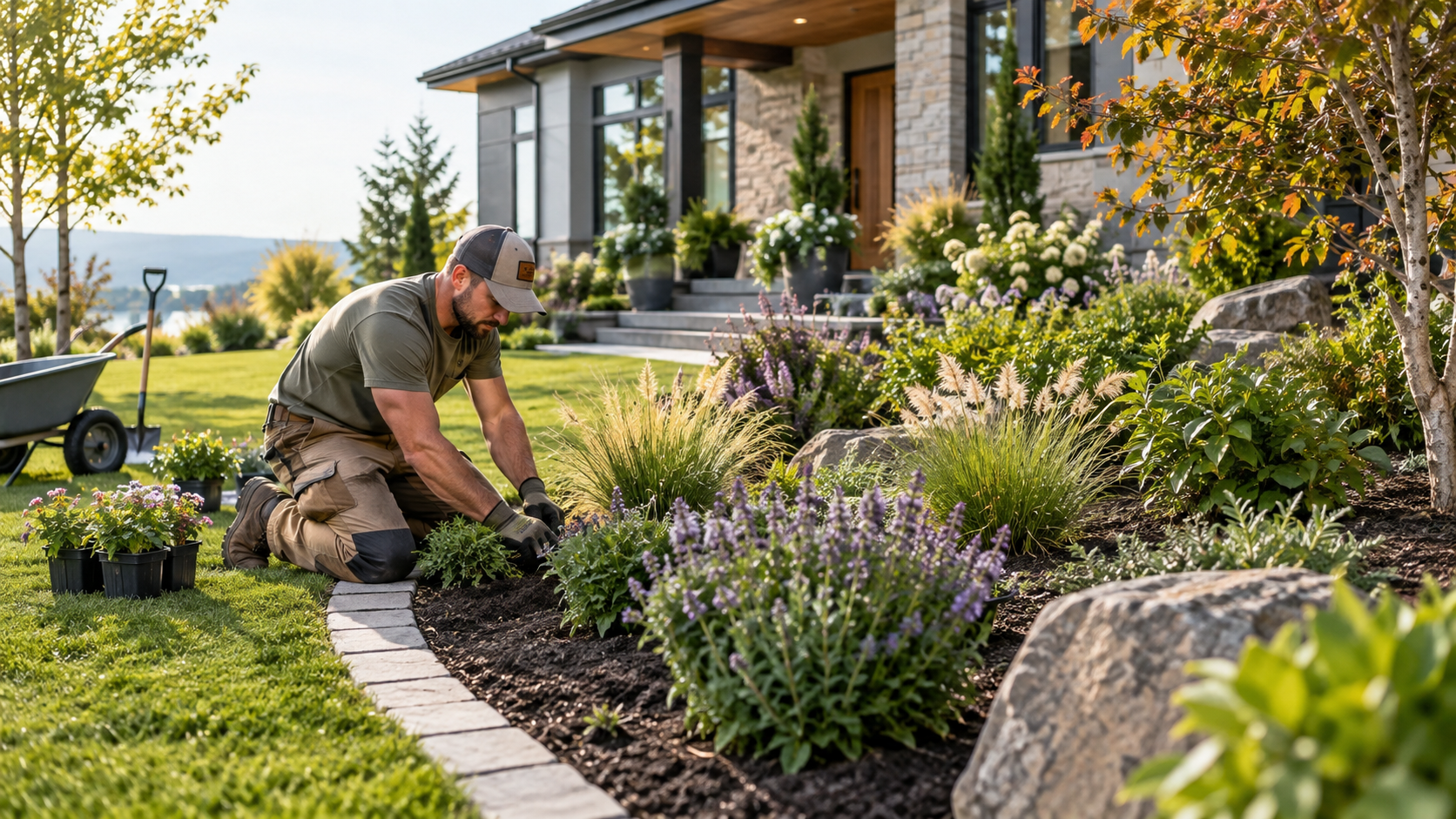
You can mow a lawn, trim a few shrubs, and still look outside thinking, “Why doesn’t this yard feel finished?”
That is usually where landscapers come into the picture.
A good landscaping professional does more than cut grass or plant flowers. Depending on the company, landscapers may design outdoor spaces, install planting beds, grade soil, build walkways, repair lawns, create drainage solutions, spread mulch, install irrigation, and keep everything maintained once the work is done.
And here is where things get a little confusing: the word “landscaper” covers a huge range of work.
One company may focus almost entirely on weekly lawn care. Another may build patios, retaining walls, drainage systems, and complete backyard makeovers. A third may specialize in planting design and garden maintenance.
So hiring landscapers is less about finding someone who “does yards” and more about matching the company to the job you actually have.
That sounds obvious, but plenty of homeowners skip that step.
They ask for three prices, compare the totals, and assume all three quotes describe the same project. Often, they do not.
Before you compare numbers, it helps to understand what landscaping work really involves.
What Do Landscapers Actually Do?
The answer depends heavily on the contractor.
Some landscapers handle routine maintenance. Others focus on installation and construction. Larger companies may offer both.
A typical residential landscaping company may provide services such as:
- Lawn mowing and edging
- Mulch installation
- Shrub and hedge trimming
- Plant and tree installation
- Garden-bed preparation
- Sod installation and lawn renovation
- Landscape lighting installation
- Irrigation or sprinkler work
- Drainage improvements
- Walkways, patios, and other hardscape features
- Seasonal cleanup
- Ongoing landscape maintenance
Not every company offers all of these.
If you need a paver patio, for example, hiring a crew that mainly cuts lawns is probably not the best fit. Likewise, a design-build company may not be interested in a small weekly mowing job.
The first question should therefore be simple: what kind of landscaper does this particular project require?
Lawn Care and Landscaping Are Not Quite the Same Thing
People use the terms interchangeably, but there is a practical difference.
Lawn-care companies usually focus on turf.
That might include mowing, fertilization, weed control, aeration, overseeding, and similar services.
Landscaping is broader.
It can include lawns, but it may also involve plants, trees, drainage, irrigation, grading, stone, wood structures, lighting, and outdoor design.
There is overlap, of course.
A landscape-maintenance company may mow the lawn and trim shrubs during the same visit. A lawn company may install new sod. Still, understanding the distinction can save time when you start calling contractors.
| Service Type | Typical Work | Best Fit For |
|---|---|---|
| Lawn care | Mowing, fertilization, aeration, weed control | Homeowners mainly concerned with turf |
| Landscape maintenance | Pruning, mulch, cleanup, lawn care, bed maintenance | Keeping an existing yard looking good |
| Landscape installation | Plants, sod, beds, irrigation, grading | Changing or rebuilding parts of a yard |
| Landscape design | Planning layout, plants, materials, circulation | Larger projects that need a clear plan |
| Hardscaping | Patios, walkways, walls, steps | Projects involving stone, concrete, or masonry |
| Drainage landscaping | Grading, drains, swales, runoff management | Wet yards or water-flow problems |
Start With the Problem, Not the Plant List
One of the easiest ways to overspend on landscaping is to begin with appearance before solving basic site problems.
You may love hydrangeas, ornamental grasses, or a particular patio style.
Fine.
But if water collects against the foundation every time it rains, drainage should probably come first.
If the backyard gets six hours of harsh afternoon sun, plants that prefer shade are going to struggle no matter how beautiful they looked at the garden center.
If deer regularly wander through the neighborhood, that matters too.
Landscaping is much easier when the design respects the property instead of fighting it.
A good landscaper will normally pay attention to sunlight, drainage, soil conditions, existing vegetation, slopes, traffic patterns, utilities, and how the homeowners actually use the yard.
A family with three kids and a dog needs a different backyard from a couple who mainly wants a quiet patio and low-maintenance planting.
Same square footage. Completely different priorities.
What Makes a Landscape Look Professionally Designed?
It is rarely one expensive plant.
Good landscapes tend to feel intentional.
Paths lead somewhere. Plants are grouped rather than scattered randomly. Mature sizes are considered. Different areas of the yard connect visually instead of looking like separate projects completed five years apart.
And empty space matters.
Homeowners sometimes want to fill every inch immediately because young plants look small. Then three years later, everything is fighting for space.
Plants grow.
Obvious, yes. Still one of the easiest things to forget when standing in a nursery.
A professional plan usually leaves enough room for plants to mature without constant aggressive pruning.
Do You Need a Landscape Designer?
Not for every project.
If you are replacing five shrubs and refreshing mulch, a formal design is probably unnecessary.
If you are rebuilding the entire front yard, moving walkways, adding a patio, changing grading, planting dozens of plants, and installing lighting, a plan becomes much more valuable.
Some landscaping contractors provide design services themselves.
Others work from plans produced by landscape designers or landscape architects.
The right level of design depends on the project’s size and technical requirements.
For major grading, structures, complex drainage, or projects affected by local codes, specialized professionals may need to be involved.
Why Landscaping Quotes Can Be So Different
You ask three landscapers for estimates.
One says $6,000.
Another says $9,500.
The third comes back at $13,000.
That does not automatically mean someone is trying to rip you off.
Look closely.
One contractor may be installing one-gallon plants while another priced larger specimens. One may include soil amendment. One may include irrigation changes. One may remove and haul away all old material while another expects you to handle disposal.
The patio material may be different.
The depth of the base beneath the pavers may be different.
The number of plants may be different.
Even mulch depth can change the material quantity noticeably on a large property.
This is why comparing only the total price can be misleading.
What Affects Landscaping Cost?
There is no useful national flat price for “landscaping a yard.”
A small mulch refresh and a complete backyard rebuild are both landscaping, but financially they have almost nothing in common.
Costs also vary by region, labor market, property access, materials, project size, and how much site preparation is needed.
| Cost Factor | Why It Matters |
|---|---|
| Project size | Larger areas require more labor and material |
| Site access | Tight gates or steep slopes can slow equipment and crews |
| Existing landscape | Removal and disposal add time and cost |
| Plant size | Larger mature plants usually cost more |
| Hardscape materials | Pavers, natural stone, concrete, and gravel vary widely in price |
| Drainage work | Excavation, piping, grading, and soil movement can increase scope |
| Irrigation changes | Moving or adding zones adds labor and materials |
| Soil condition | Poor or compacted soil may need amendment or replacement |
| Permits | Some structures or site changes may need local approval |
| Maintenance level | Some designs require more pruning, watering, and seasonal care |
Cheap Landscaping Can Become Expensive Pretty Fast
There are places where saving money makes perfect sense.
Maybe you use smaller plants and wait a few years for them to mature.
Maybe you install the project in phases.
Maybe you keep an existing patio rather than replacing it.
Those are reasonable compromises.
Problems start when the savings come from skipping the parts you cannot easily see.
A paver patio needs a suitable base.
Drainage needs somewhere for water to go.
Plants need appropriate conditions.
Grading has to move water in the right direction.
Saving money by ignoring those pieces can create a yard that looks great for one season and becomes a repair project later.
Ask What Is Included in the Estimate
A useful landscaping proposal should tell you more than one big number.
For larger projects, you want enough detail to understand what is being built.
Ask about:
- Removal of existing plants or materials
- Disposal and hauling fees
- Plant names, sizes, and quantities
- Mulch type and approximate depth
- Soil preparation
- Sod or seed type
- Hardscape materials
- Base preparation for patios and walkways
- Drainage work
- Irrigation adjustments
- Cleanup after installation
- Plant or workmanship warranties
If something matters to you, get it in writing.
“Install landscaping in front yard” leaves plenty of room for misunderstanding.
“Install six three-gallon shrubs, twelve one-gallon perennials, hardwood mulch, and drip irrigation modifications” is much clearer.
Plants Should Match the Site
This seems basic, but it is one of the biggest differences between landscaping that matures gracefully and landscaping that becomes constant work.
Plants have preferences.
Some like full sun. Others burn in it.
Some tolerate wet soil. Others develop problems if their roots stay waterlogged.
Some stay compact. Others quietly become fifteen-foot monsters while you are not paying attention.
The mature size on the plant tag matters far more than the size of the plant on installation day.
Also consider maintenance.
A beautifully clipped formal hedge may look incredible, but someone has to keep clipping it.
If you want a low-maintenance landscape, say that early.
It affects plant selection, bed layout, lawn area, irrigation, and how much pruning will be needed later.
Native Plants Can Make Sense, but “Native” Is Not Magic
Native plants have become much more visible in residential landscaping, and for good reason.
Plants native to a region can support local insects and wildlife and may be well adapted to regional conditions.
But native does not mean a plant can be placed anywhere and forgotten.
A plant native to a wet meadow may struggle in a dry foundation bed.
A woodland species may hate an exposed parking-strip location.
You still have to match the plant to the site.
Native species can be part of a practical, attractive landscape, especially when selected for the actual conditions around the home.
Watering Matters Most Right After Planting
One frustrating landscaping story repeats itself every year.
New plants go in.
Everything looks fantastic.
Then the homeowner assumes the irrigation system will handle it automatically.
A few weeks later, several plants are struggling.
New plants need time to establish roots beyond the original root ball.
During that period, watering usually needs more attention than it will once the landscape is established.
The exact schedule depends on plant type, climate, soil, weather, and irrigation setup.
Ask the landscaper for specific watering instructions after installation.
Do not rely on a vague “water regularly.”
Too Much Water Can Be a Problem Too
More is not always better.
Constantly saturated soil can stress many plants just as badly as drought.
If you see yellowing leaves, wilting, or poor growth, do not automatically assume the plant is thirsty.
Check the soil.
Drainage and irrigation should work together.
A landscape with poor drainage may need less irrigation, not more.
Mulch Is Useful, but There Is a Limit
Mulch can reduce weed pressure, slow moisture loss, moderate soil temperature, and make planting beds look finished.
But piling mulch against tree trunks is not better landscaping.
You have probably seen the famous “mulch volcano” where a tree looks like it is emerging from a small brown mountain.
That practice can hold moisture against the trunk and cause problems.
Mulch should generally cover the soil while staying away from direct contact with tree trunks and woody stems.
More mulch is not automatically more professional.
Drainage Should Be Taken Seriously
Water always wins.
You can hide a drainage problem with plants for a while, but if runoff regularly moves toward the house or pools in the same low area, eventually the problem comes back.
Landscapers may address drainage through grading, swales, catch basins, underground piping, dry creek features, soil changes, or other site-specific methods.
The important part is the destination.
Where will the water go?
A drain that simply moves water from one problem area to another is not much of a solution.
Drainage work may also be affected by local rules and neighboring properties. Water should not simply be redirected in a way that creates a new problem next door.
Landscapers and Irrigation Systems
Planting a new landscape without checking the irrigation system can cause headaches quickly.
Existing sprinkler heads may now be blocked by shrubs.
A lawn zone may be watering a new drought-tolerant planting bed far more than necessary.
Drip irrigation may make more sense in certain areas.
Landscape changes sometimes require irrigation changes.
Ask whether irrigation adjustments are part of the proposal or whether another contractor will handle them.
Hardscaping Changes the Project Completely
Once patios, walls, steps, walkways, or other built elements enter the plan, the job becomes more construction-heavy.
Preparation matters.
Pavers installed over an inadequate base can settle or shift.
Retaining walls have to manage soil pressure and drainage.
Steps have to be comfortable and consistent.
Patios need appropriate slope so water does not sit against the house.
This is work where experience matters.
A beautiful finished surface tells only half the story. The layers underneath often determine how long it stays beautiful.
Should You Landscape Everything at Once?
Not necessarily.
Phased landscaping can be a smart way to control cost.
The key is planning the entire property before completing the first phase.
Otherwise, phase two may require ripping up something installed during phase one.
If you eventually want a patio, outdoor kitchen, drainage system, lighting, and planting beds, tell the landscaper now even if you are only building the patio this year.
The long-term plan can affect conduit placement, irrigation, grading, access, and plant locations.
How to Choose Landscapers
You do not need fifty estimates.
You do need enough information to compare companies intelligently.
Look for experience with projects similar to yours.
A contractor who builds beautiful patios may not necessarily be the strongest planting designer. A talented maintenance crew may not be the right choice for complex drainage.
Ask to see previous work.
Ask whether the company carries appropriate insurance.
For work requiring licenses, permits, or specialized trades in your location, confirm the company meets the applicable local requirements.
And pay attention to communication.
If getting a clear answer before the contract is signed feels impossible, communication probably will not become magically easier halfway through the project.
Questions Worth Asking Before You Hire
- Have you completed similar projects?
- Who will supervise the work?
- What exactly is included in the quote?
- What is specifically excluded?
- Who handles permits if they are required?
- How will existing plants and structures be protected?
- What happens if additional work is discovered?
- How are change orders handled?
- What warranty is provided?
- Who is responsible for watering new plants?
- What maintenance will the new landscape need?
- How will drainage be handled?
Do Not Forget About Underground Utilities
Landscaping can involve a surprising amount of digging.
Trees, fence posts, irrigation lines, drainage pipes, lighting, retaining walls, and even deep planting holes can interfere with buried utilities.
In the United States, utility-location procedures are an important part of planning excavation.
Professional contractors should understand the requirements that apply to the project.
This is not an area where guessing is a good idea.
What About Trees?
Trees deserve more thought than most landscape plants because mistakes get bigger every year.
A small tree placed too close to the house may look harmless during installation.
Ten years later, branches may be scraping the roof and roots may be competing for space near hardscape.
Consider mature canopy width, root space, overhead utilities, underground utilities, sun exposure, and distance from structures.
Major pruning or hazardous tree work may be better handled by qualified tree-care professionals rather than a general landscape crew.
Maintenance Begins the Day Installation Ends
A finished landscape is not frozen in time.
Plants grow.
Mulch breaks down.
Weeds appear.
Irrigation needs adjustment.
Shrubs eventually need pruning.
Trees drop leaves at exactly the moment you thought the yard was finally clean.
Ask what the landscape will require one year, three years, and five years from now.
This is especially useful if your main goal is low maintenance.
A design can look simple on installation day and become labor-intensive as plants mature.
What Does “Low-Maintenance Landscaping” Really Mean?
It does not mean zero maintenance.
There is no magical yard that never grows weeds, never needs pruning, and somehow cleans itself after a storm.
Low maintenance means reducing repetitive work.
That may involve fewer high-maintenance shrubs, properly spaced plants, less lawn, efficient irrigation, practical edging, and materials suited to the location.
It may also mean resisting the urge to cram twenty different plant varieties into a small bed.
Simple can look very good.
How Long Does a Landscaping Project Take?
It depends on the job.
A small planting project may take a day.
A full backyard renovation involving demolition, grading, drainage, hardscape, irrigation, and planting can take much longer.
Weather matters too.
Heavy rain can turn excavation areas into mud. Extreme heat can affect planting schedules. Material delays can slow hardscape projects.
Ask for an estimated timeline, but expect some flexibility when the work depends heavily on weather and site conditions.
Should You Stay Home During the Work?
Usually, no.
You may want to be available at the beginning of the project and during key decisions, especially if layout details are being confirmed onsite.
For example, look at the actual proposed position of a patio edge or tree before installation.
Moving a garden hose ten feet is easy.
Moving a finished retaining wall ten feet is another matter entirely.
Walk the Project Before Final Payment
Once the work is finished, walk through the property with the contractor.
Look at planting locations, irrigation coverage, patio edges, drainage, cleanup, and any areas discussed in the contract.
Ask questions while the crew and project details are still fresh.
If the project includes new plants, confirm watering instructions.
If there is lighting, learn how the timer or controls work.
If irrigation was changed, understand the new zones.
This is also a good moment to photograph the completed project for your records.
FAQ About Landscapers
What do landscapers usually do?
Landscapers may handle planting, lawn work, mulch, irrigation, drainage, grading, hardscaping, lighting, garden design, and ongoing maintenance. Services vary by company, so ask what is included before hiring.
How much do landscapers cost?
Pricing depends on the project, materials, labor, property access, location, plant sizes, site preparation, and whether hardscaping or drainage work is involved. Detailed quotes are more useful than broad national averages.
What is the difference between landscapers and lawn-care companies?
Lawn-care companies generally focus on turf services such as mowing, fertilizing, weed control, and aeration. Landscapers may work on the entire outdoor space, including plants, beds, drainage, irrigation, patios, and other features.
Should I get multiple landscaping quotes?
For a larger project, comparing several detailed proposals can be useful. Make sure each quote covers a similar scope, plant size, material quality, site preparation, and cleanup before comparing the totals.
When is the best time to hire landscapers?
The ideal timing depends on climate and project type. Planting, hardscaping, irrigation, and maintenance projects each have different seasonal considerations. Planning early also helps if local landscapers become busy during peak seasons.
Do landscapers provide warranties on plants?
Some do, but policies vary widely. A plant warranty may depend on proper watering and maintenance by the homeowner. Ask for the warranty terms in writing before installation.
Can landscapers fix drainage problems?
Many landscaping companies handle grading and residential drainage, while more complex situations may require specialized professionals. The right solution depends on where the water comes from, where it collects, and where it can safely go.
Conclusion: Good Landscaping Starts With a Good Plan
Hiring landscapers can change the way a property feels.
A neglected side yard becomes useful.
A muddy backyard becomes a patio and lawn.
An awkward front entrance suddenly feels intentional.
And sometimes the improvement is much simpler: healthy plants, clean bed lines, fresh mulch, and a lawn that finally looks like someone meant for it to be there.
But good landscaping is not just decoration.
The best projects solve practical problems at the same time.
They move water away from the wrong places.
They create shade where people actually sit.
They keep mature plants from blocking windows.
They make walkways comfortable.
They reduce maintenance rather than quietly creating three extra hours of yard work every Saturday.
That is why planning matters so much.
Before calling landscapers, decide what bothers you about the current yard.
Maybe there is nowhere comfortable to sit.
Maybe the lawn refuses to grow under mature trees.
Maybe water pools near the patio.
Maybe the front of the house simply feels bare.
Those problems give the project direction.
Then decide how much maintenance you realistically want.
Not fantasy-you who wakes up every Saturday excited to prune twenty shrubs.
Actual you.
If you want to spend five minutes watering pots and then enjoy the yard, say so.
If gardening is your hobby and you genuinely want interesting plants to care for, that is useful information too.
Next, think about the long term.
A young shrub is tiny.
A young tree is adorable.
Neither stays that way.
Good landscapers plan for mature size, not just installation-day appearance.
That one habit prevents a surprising amount of future pruning, removal, and frustration.
For larger projects, insist on clarity before work begins.
You should understand what is being removed, what is being installed, which materials are being used, how drainage will work, whether irrigation is changing, and what maintenance will be required afterward.
Do not compare quotes only by the bottom number.
A less expensive proposal may be completely reasonable, but make sure it is actually offering the same thing.
Check plant sizes.
Check quantities.
Check hardscape materials.
Check whether demolition and disposal are included.
Check soil preparation.
Check irrigation.
Check cleanup.
The differences often hide in those details.
And if drainage is part of the project, give it the attention it deserves.
A beautiful yard with water moving toward the foundation is not a successful landscape.
The pretty parts and practical parts should work together.
After installation, expect the landscape to change.
That is the fun part.
Perennials fill in.
Trees create more shade.
Shrubs soften the architecture.
A patio that looked slightly exposed the first summer can feel settled and private a few seasons later.
Good landscaping usually improves with age.
But it only does that when the plants and materials were suitable from the start.
So when comparing landscapers, do not just ask, “How much?”
Ask how they reached the design.
Ask why those plants were selected.
Ask what happens when they mature.
Ask where the rainwater goes.
Ask what the yard will require from you once the crew leaves.
The best answer is not always the fanciest one.
Sometimes it is a smaller patio, fewer plants, better drainage, and a yard you can actually maintain.
That is the real goal.
Not a property that looks incredible for the first photo.
A property that still works, grows well, and feels good years later.



Leave a Reply