
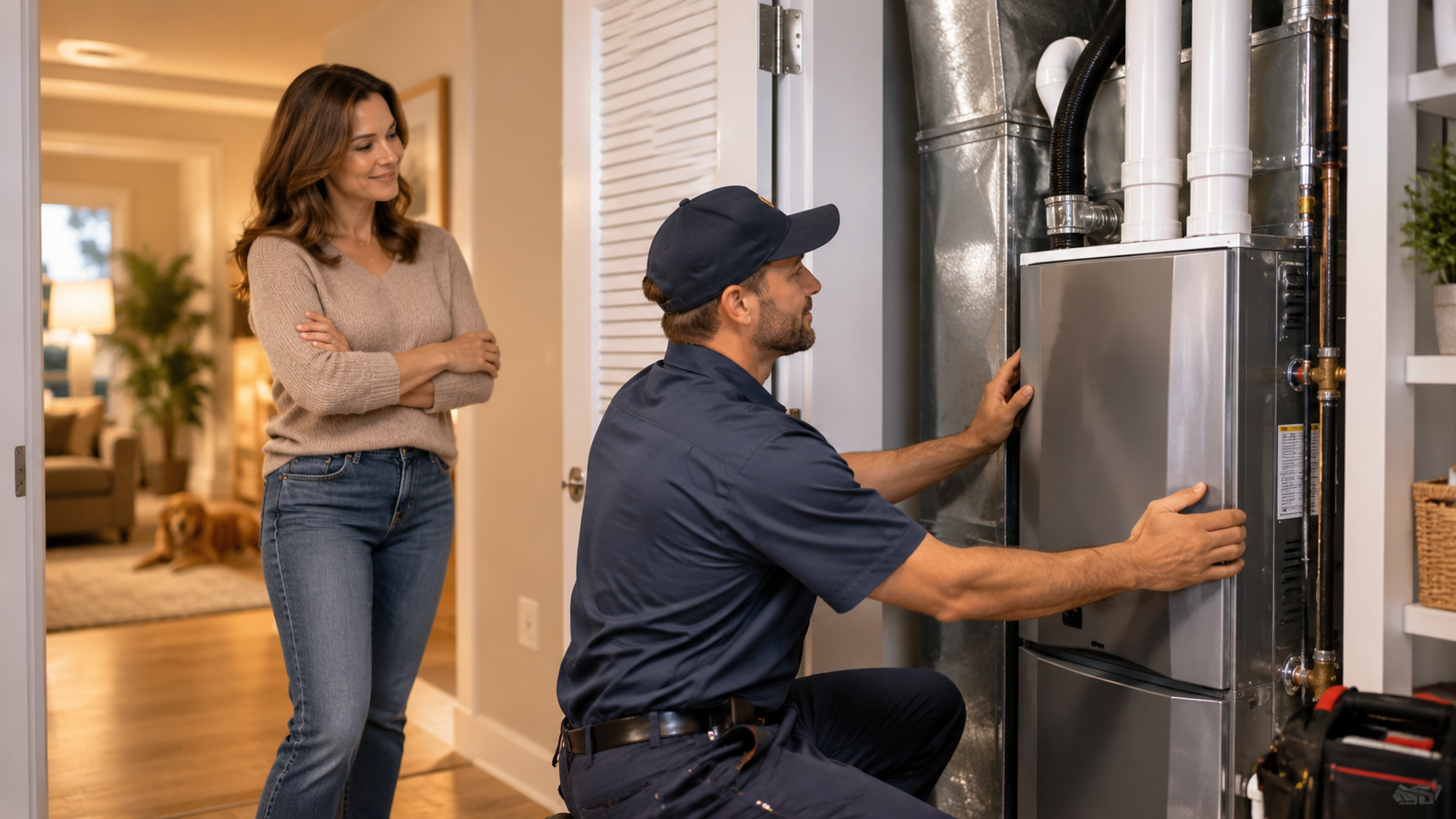
A furnace rarely quits at a convenient time.
It usually happens on a cold morning, right before guests arrive, or during the week when your calendar is already packed. Suddenly, a machine you barely thought about becomes the most important appliance in the house.
That is when furnace replacement can feel rushed.
The technician says the repair will be expensive. The furnace is old. You start looking at new systems and immediately run into AFUE ratings, BTUs, variable-speed blowers, two-stage burners, heat pumps, warranties, permits, and estimates that seem to include completely different things.
It is a lot.
But replacing a furnace does not have to become a crash course in HVAC engineering.
Most homeowners really need answers to a few practical questions. Is replacement actually necessary? What size furnace does the house need? How much efficiency makes sense? What should be included in the quote? And how can you tell whether the new system is being installed correctly?
Those questions matter far more than simply picking the furnace with the longest feature list.
Here is the bigger point: furnace replacement is not just buying a new metal box. You are changing one part of a heating system that also includes ducts, airflow, controls, venting, electrical connections, fuel supply, and the house itself.
Get those pieces working together and the new furnace should quietly do its job for years.
How Do You Know It Is Really Time to Replace a Furnace?
Age gets most of the attention, but age alone does not decide whether a furnace needs replacement.
An older furnace that heats the home evenly, operates safely, and has needed only minor repairs may still have useful life left. Meanwhile, a younger furnace with repeated major failures can become a money pit surprisingly fast.
The real question is not, “How old is it?”
It is, “What condition is it in, and what is likely to happen next?”
Replacement becomes more reasonable when several issues start appearing together. Maybe the furnace needs frequent service. Maybe the blower is noisy. Maybe the heat exchanger has a serious problem. Maybe your heating bills keep rising while comfort keeps getting worse.
One expensive repair does not automatically mean a new furnace is required. But one expensive repair on top of several earlier repairs changes the conversation.
Signs That Furnace Replacement Deserves a Serious Look
- The furnace needs repairs almost every heating season
- A major component has failed and the unit is already old
- The furnace struggles to maintain comfortable temperatures
- Heating feels increasingly uneven from room to room
- The unit cycles on and off unusually often
- Operating noise has increased noticeably
- Replacement parts are becoming difficult or expensive to obtain
- Fuel use has increased without an obvious change in weather or habits
- There are safety concerns involving combustion or venting
A qualified HVAC professional should evaluate safety problems rather than relying on age or online checklists alone.
If a fuel-burning furnace has a confirmed heat exchanger failure, improper venting, gas-related issue, or other combustion concern, safety comes first.
Repair or Replace? The Math Is Not Always Obvious
Suppose a repair costs $700.
That sounds much better than spending several thousand dollars on a new system. And sometimes it is.
But context matters.
If the furnace is relatively young and otherwise reliable, repairing it may be perfectly sensible. If the system is approaching the end of its useful life and has already needed several costly repairs, spending another $700 may simply delay replacement for a short time.
Think about the likely next few years rather than only today’s invoice.
You should also consider whether a replacement would solve other problems you already have. If the existing furnace is oversized, loud, uncomfortable, or poorly matched to the duct system, replacing it with a correctly selected system may improve daily comfort in addition to reducing repair risk.
| Situation | Repair May Make Sense | Replacement May Make More Sense |
|---|---|---|
| Furnace age | Relatively young | Older and nearing expected service-life range |
| Repair history | Few previous problems | Repeated repairs in recent years |
| Current repair | Minor component | Major or expensive component |
| Comfort | Home heats evenly | Persistent hot and cold rooms |
| Efficiency | Fuel costs remain reasonable | Operating costs are becoming a concern |
| Safety | No known safety issue | Serious combustion or venting concern |
| Parts | Readily available | Difficult or expensive to source |
There is no magic formula that makes the choice automatically.
A good contractor should be able to explain both paths rather than pushing replacement simply because a furnace is old.
Do Not Automatically Buy the Same Size Furnace Again
This is one of the most important things to understand about furnace replacement.
The capacity of your old furnace does not prove that the house needs the same capacity today.
Older homes were often equipped using rough sizing rules. Some systems were intentionally oversized because bigger equipment seemed safer.
Then the house changed.
Windows may have been replaced. Attic insulation may have been added. Air leaks may have been sealed. Doors may fit better. An addition may have changed the layout.
All of that affects heating demand.
A proper replacement should consider the home’s current heating load rather than simply copying the label from the old unit.
Why Furnace Sizing Matters So Much
An oversized furnace can heat the house quickly, but that is not always a good thing.
It may turn on, blast out heat, reach the thermostat setting quickly, and shut down. Then the temperature drops and the whole cycle starts again.
This short cycling can affect comfort and equipment wear.
The rooms closest to the furnace may warm quickly while distant rooms still feel cool. The system shuts off before airflow has had much time to even things out.
An undersized furnace has the opposite problem.
It may run almost constantly during very cold weather and still struggle to reach the thermostat setting.
The target is not “as big as possible” or “as small as possible.”
It is enough capacity for the actual house.
HVAC contractors commonly use residential load calculations based on factors such as climate, insulation, windows, orientation, air leakage, exterior surfaces, and floor area. ACCA Manual J is a widely recognized method used for residential heating and cooling load calculations in the United States.
Square Footage Alone Is Not Enough
Two 2,000-square-foot homes can have very different heating needs.
One may be a newer home with good insulation, modern windows, and relatively low air leakage. Another may be an older house with original windows, a poorly insulated attic, and a crawl space that feels like the outdoors.
Same floor area. Very different load.
This is why rules such as “X BTUs per square foot” are rough estimates, not a substitute for proper system sizing.
Understanding Furnace Efficiency Without Getting Lost in Numbers
Gas and oil furnaces are commonly described with an AFUE rating, short for Annual Fuel Utilization Efficiency.
The rating provides a way to compare how much of the fuel’s energy is converted into useful heat over a typical heating season.
A higher AFUE generally means less energy is lost through the combustion and venting process.
That sounds like higher efficiency must always be the smartest purchase.
But there is a nuance.
Higher-efficiency equipment may cost more upfront and may require different venting or condensate drainage. The financial benefit depends on your climate, fuel prices, how much heat the house needs, and how long you expect to own the property.
If the furnace barely runs during a mild winter, the savings from a small increase in efficiency may be modest.
In a colder region where the furnace works hard for months, efficiency can matter much more.
Single-Stage, Two-Stage, or Modulating?
Efficiency is not the only difference between furnaces.
The way a furnace produces heat also affects comfort.
A single-stage furnace generally operates at full heating output whenever the thermostat calls for heat.
A two-stage furnace can operate at a lower output during lighter heating demand and move to a higher stage when more heat is needed.
A modulating furnace can adjust output across a broader range.
The advantage of staged or modulating equipment is not that your house becomes warmer. Any correctly sized furnace should be able to heat the house.
The difference is how it gets there.
Longer, gentler heating cycles can create more even temperatures and reduce the feeling of hot blasts followed by cooler periods.
The Blower Motor Deserves Attention Too
Homeowners naturally focus on the burner because that is where the heat comes from.
But the blower determines how that heat moves through the home.
Some modern furnaces use variable-speed blower motors that adjust airflow based on operating conditions.
That can help the system run more quietly and maintain more consistent airflow.
The blower also matters if the same duct system supports central air conditioning.
A furnace replacement can therefore affect cooling performance too, especially when airflow settings are changed.
Your Ductwork May Matter More Than the Furnace Brand
A premium furnace cannot overcome badly designed ducts.
If a bedroom has always received weak airflow, replacing the furnace may not fix the bedroom.
The problem could be an undersized branch duct, crushed flexible duct, inadequate return air, leakage, or a poor layout.
Old duct systems deserve attention during furnace replacement because the new equipment has to work through them.
Ask the contractor whether the existing system can handle the required airflow.
This is especially important when changing equipment capacity or installing a more advanced blower.
Duct Problems Worth Checking Before Replacement
- Weak airflow from certain vents
- Large temperature differences between rooms
- Whistling at return-air grilles
- Visible disconnected or damaged ducts
- Crushed flexible duct runs
- Ductwork located in hot attics or cold crawl spaces
- Excessive air leakage around duct joints
- A return system that seems small for the house
Not every older duct system needs full replacement.
Sometimes sealing, repairing, resizing a transition, or correcting one bad section can make a noticeable difference.
What Does Furnace Replacement Usually Involve?
The old furnace has to come out first, but the project involves much more than removing one appliance and sliding another into its place.
The contractor should safely disconnect electrical power, fuel connections, venting, controls, and duct transitions as needed.
The new furnace is then positioned and connected to the existing system.
Depending on the model, the job may involve new vent piping, condensate drainage, electrical changes, gas piping adjustments, a new filter rack, thermostat work, or duct modifications.
The furnace then needs to be started, tested, and adjusted.
That last part is easy for homeowners to overlook.
A furnace can turn on and produce warm air while still being poorly set up.
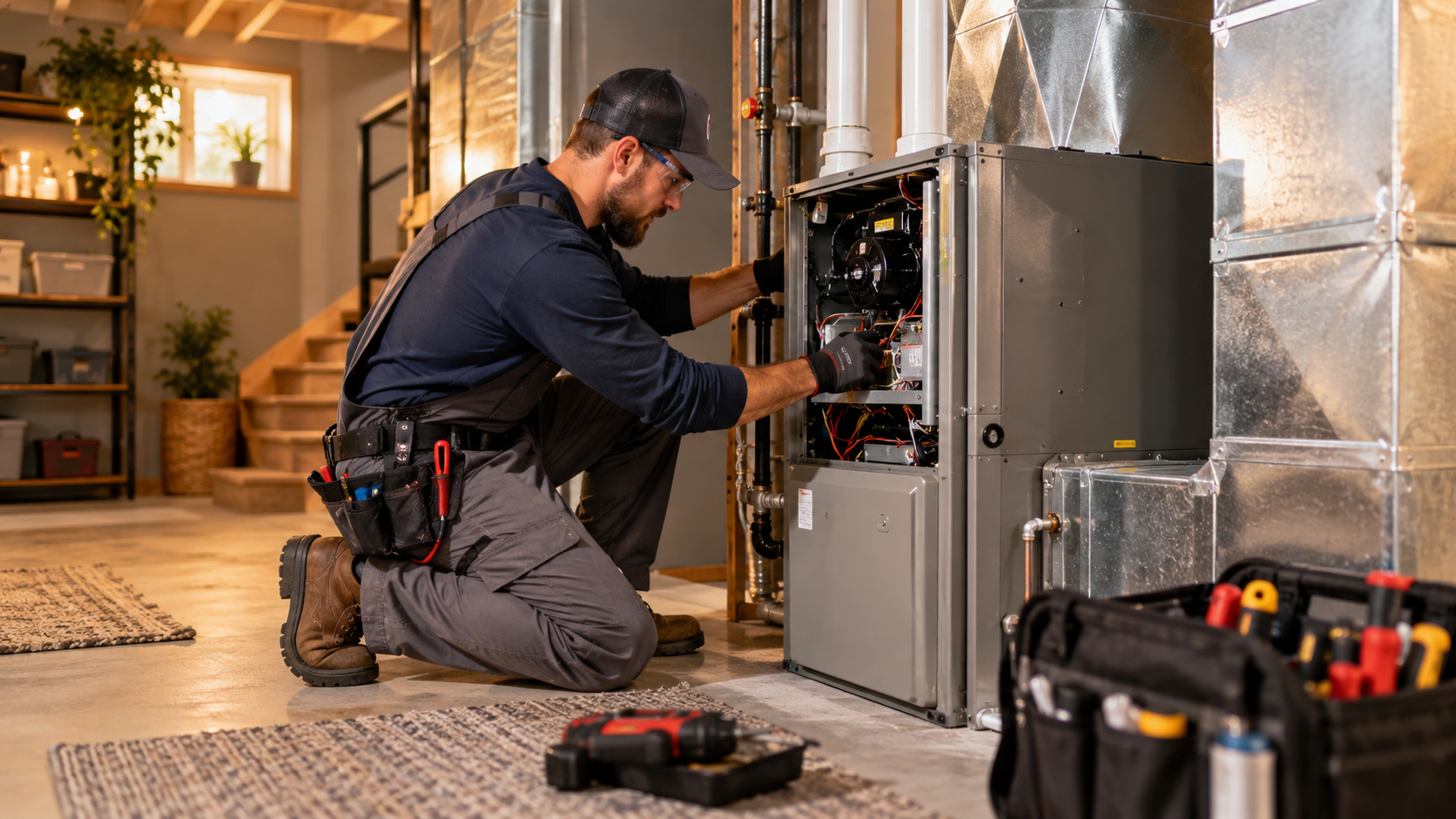
Proper commissioning may involve checking airflow, temperature rise, combustion performance, gas pressure where applicable, safety controls, thermostat operation, and other manufacturer-required items.
High-Efficiency Furnaces Can Change the Venting Setup
If you are replacing an older gas furnace with a high-efficiency condensing model, do not assume the existing flue remains the same.
Condensing furnaces commonly use a different venting approach from many older conventional units.
They also create condensate that needs proper drainage.
This can affect installation cost and placement.
It may also create practical questions about where vent pipes exit the home and where condensate can drain safely.
These details should appear in the installation plan rather than becoming surprises halfway through the job.
What About the Chimney?
Older furnaces are often connected to masonry chimneys or metal vent systems.
When that furnace is replaced, the chimney may need evaluation, especially if another fuel-burning appliance such as a water heater also uses it.
Changing one appliance can affect how the remaining appliance vents.
This is another reason furnace replacement is not simply an appliance swap.
Carbon Monoxide Safety Matters
Fuel-burning furnaces need correct combustion and venting.
Improper operation can create carbon monoxide risks.
Homes with fuel-burning appliances should have properly located carbon monoxide alarms according to applicable requirements and alarm-manufacturer instructions.
An alarm is not a substitute for correct furnace installation.
Think of it as another layer of protection.
If a carbon monoxide alarm activates, follow its safety instructions and contact appropriate emergency or qualified service professionals. Do not assume everything is fine because the furnace still appears to run normally.
What Does Furnace Replacement Cost?
There is no useful single price for every house in the United States.
Labor costs differ by region. Equipment varies widely. Some replacements are straightforward. Others involve venting, electrical work, duct repairs, gas changes, permits, difficult attic access, or major alterations around the furnace.
Two homeowners can purchase furnaces with similar specifications and end up with very different project totals.
| Cost Factor | Why It Can Change the Price |
|---|---|
| Furnace capacity | Equipment size affects model selection and price |
| Efficiency level | Higher-efficiency systems may cost more and require installation changes |
| Single-stage vs. advanced models | Two-stage and modulating equipment usually costs more |
| Blower technology | Variable-speed equipment often carries a higher upfront price |
| Venting changes | New vent materials or routes add labor and materials |
| Duct modifications | Transitions, repairs, or resizing increase project scope |
| Electrical work | Controls, circuits, or wiring may require changes |
| Gas-line work | Fuel piping adjustments add labor |
| Installation location | Tight closets, attics, and crawl spaces can take more time |
| Permits and inspections | Requirements and fees vary by jurisdiction |
| Thermostat | Advanced equipment may need compatible controls |
| Removal and disposal | Old equipment disposal may be included or billed separately |
When comparing estimates, compare what is included rather than looking only at the final number.
Why Furnace Quotes Can Look So Different
One contractor may quote a basic single-stage furnace.
Another may recommend a two-stage unit with a variable-speed blower.
A third may include duct repairs, a thermostat, a new filter cabinet, permit fees, and venting changes.
All three numbers can look wildly different even though they are technically quotes for “furnace replacement.”
This is why you should ask for a clear scope of work.
You want to know the exact model, heating capacity, efficiency rating, included accessories, venting work, thermostat, permits, labor warranty, and any planned duct modifications.
What Should Be Included in a Good Furnace Replacement Quote?
- Exact furnace make and model
- Heating capacity
- Efficiency rating
- Equipment staging or modulation type
- Blower type
- Removal and disposal of the old furnace
- Required venting or condensate work
- Planned duct transitions or modifications
- Thermostat details
- Permit responsibility
- Manufacturer warranty information
- Contractor labor warranty
- Startup and commissioning work
Written details make comparing proposals much easier.
They also reduce the chance of discovering later that something you assumed was included was actually an extra.
Do You Need a New Thermostat?
Not necessarily.
A compatible existing thermostat may continue working perfectly well with a new furnace.
But advanced multi-stage or communicating equipment may require different controls to operate all available features.
If a contractor recommends a new thermostat, ask why.
Sometimes the reason is technical compatibility.
Sometimes the old thermostat simply lacks features the homeowner wants.
Those are two different conversations.
Should You Replace the Air Conditioner at the Same Time?
Furnaces and central air conditioners often share indoor equipment and the same blower.
That does not mean you automatically need to replace both.
If the air conditioner is relatively new and compatible with the new furnace, keeping it may be sensible.
If both systems are old, replacement together deserves consideration.
Coordinating both projects can sometimes reduce duplicated labor and make equipment matching easier.
Ask how old the cooling system is, what condition it is in, and whether the proposed furnace affects compatibility.
Could a Heat Pump Be an Alternative?
Furnace replacement is also a reasonable moment to ask about heat pumps.
A heat pump can provide both heating and cooling, and modern equipment can operate in colder climates than many homeowners realize.
That does not automatically make a heat pump the right answer for every home.
Electric rates, fuel costs, climate, ductwork, electrical capacity, available equipment, and heating load all matter.
Some homes also use dual-fuel setups that combine a heat pump with a furnace.
You do not have to abandon the furnace plan. But if major HVAC work is already happening, this is a practical time to understand the alternatives.
Permits Are Not Just Paperwork
Permit requirements differ across cities, counties, and states.
Many jurisdictions require permits for furnace replacement, especially when gas, electrical, mechanical, or venting work is involved.
An inspection may follow.
Ask the contractor who obtains the permit and whether the fee is included in the price.
Skipping required permits can create problems later during property sales, insurance questions, or future HVAC work.
How Long Does Furnace Replacement Take?
A straightforward replacement may often be completed within a working day.
More involved jobs can take longer.
Changing furnace location, rebuilding duct transitions, adding venting, modifying gas lines, replacing electrical components, or working in a difficult attic can extend the project.
Weather matters too.
If the replacement is happening during freezing conditions, ask approximately how long the house will be without heat.
How to Prepare for Installation Day
You do not need to turn the house into a construction site before the crew arrives.
A little preparation helps, though.
Clear boxes, storage bins, laundry, tools, and other items away from the furnace. Make sure technicians have a clear path from the entrance to the equipment.
If the furnace is in an attic or basement, clear the access area too.
Keep pets away from open doors, tools, wiring, and work zones.
If you work from home, expect some noise and periods when heating is unavailable.
Do Not Ignore the Filter Setup
Filters are not exciting, but the filter arrangement you accept during installation may be with you for years.
Ask where the filter goes.
Ask what size it is.
And actually try to imagine replacing it yourself.
If the filter is hidden behind an awkward panel in a cramped corner, you will probably hate that arrangement every few months.
A convenient filter cabinet can make routine maintenance much easier.
Also remember that more restrictive filtration is not automatically better. The filter and duct system have to allow proper airflow for the equipment.
What Happens After the New Furnace Starts?
The first startup is not the end of the job.
The installer should make sure the equipment is operating within its required specifications.
Depending on the system, this may include testing temperature rise, airflow, combustion, venting, gas pressure, drainage, safety controls, thermostat operation, and blower settings.
Ask whether the system was commissioned and what was checked.
You do not need every technical number memorized.
You just want confirmation that the equipment was tested rather than simply switched on.
What Should a New Furnace Feel Like?
Ideally, not very dramatic.
The house should warm steadily.
The furnace should not create violent blasts of air or constant rapid cycling.
The thermostat should control temperature normally.
You may notice different sounds compared with the old system, especially if the new furnace has a variable-speed blower.
Still, loud rattling, grinding, repeated shutdowns, water leaks, gas odors, or clearly abnormal behavior deserve prompt attention.
How Long Should a Replacement Furnace Last?
No furnace comes with a guaranteed lifespan.
How long it lasts depends on equipment quality, installation, climate, usage, maintenance, airflow, filter condition, and the environment around the furnace.
A correctly installed system with good airflow generally has a better chance of long service than the same model operating with a clogged filter and restricted ducts.
The installation matters as much as the badge on the cabinet.
Maintenance After Furnace Replacement
Keep it simple.
Check filters according to the filter and equipment guidance. Do not block return-air grilles with furniture. Pay attention to changes in sound or operation.
Schedule professional maintenance as appropriate for your equipment and local conditions.
Keep the area around the furnace accessible rather than turning the mechanical room into permanent storage.
And save the paperwork.
Keep the invoice, model and serial numbers, warranty information, permit records, and installer contact details together.
You may not look at them for years.
Then one January morning you will be very happy they are easy to find.
Common Furnace Replacement Mistakes
The biggest mistakes are often not dramatic.
They are small shortcuts that affect comfort for years.
One is copying the old furnace size without checking whether it was correct.
Another is ignoring the duct system.
Homeowners also sometimes focus heavily on brand while barely asking about installation quality.
The brand matters. But a respected furnace installed poorly can still perform badly.
And do not assume the highest-efficiency model is automatically the smartest financial decision.
Look at the complete project.
How to Compare Contractors Without Becoming an HVAC Expert
You do not need to understand every pressure reading or wiring diagram.
Listen to how the contractor explains the project.
Can they explain why they selected the proposed furnace size?
Did they look at the ductwork?
Can they explain venting changes?
Are permits included?
Do they discuss startup testing?
Are warranty terms written clearly?
A contractor should be able to explain these things in plain language.
If every question gets answered with “That is just how we always do it,” keep asking.
FAQ About Furnace Replacement
How do I know when I need furnace replacement?
Replacement may make sense when an older furnace needs repeated repairs, has a serious component failure, struggles to heat the home, or presents safety concerns. A qualified HVAC professional can assess the equipment before you decide.
How much does furnace replacement cost?
Cost varies widely by furnace type, efficiency, capacity, labor rates, venting, duct modifications, permits, location, and installation difficulty. Compare detailed written quotes rather than relying on a single national average.
Should I replace a 20-year-old furnace if it still works?
Not automatically. Age increases the chance of repairs and declining reliability, but condition matters too. If it operates safely and reliably, you may have time to plan rather than replace it immediately.
Can I replace my furnace with the same size?
Possibly, but the old size should not be copied without checking the home’s current heating load. Insulation, windows, air sealing, and other changes may mean the correct capacity is different now.
How long does furnace replacement usually take?
A straightforward replacement can often be completed within a day. Projects involving ductwork, venting, electrical changes, gas piping, difficult access, or equipment relocation may take longer.
Do I need new ductwork when replacing a furnace?
Not always. Existing ducts can often remain, but they should be checked for condition, leakage, airflow, and sizing. Persistent hot and cold rooms may point to duct problems that a new furnace alone will not solve.
Should I replace my furnace and air conditioner together?
It depends on the age, condition, and compatibility of the cooling system. If the air conditioner is newer and compatible, keeping it may make sense. If both systems are aging, replacing them together is worth discussing.
Conclusion: Replace the System, Not Just the Box
Furnace replacement looks simple from the outside.
Old furnace out. New furnace in.
But the better way to think about it is as a heating-system project.
The furnace has to match the house. The blower has to move the right amount of air. The ducts have to carry that air. Venting has to work correctly. The thermostat has to communicate with the equipment. Safety controls have to function. The installation needs to meet applicable requirements.
That is why the cheapest furnace is not automatically the cheapest project.
And the most expensive furnace is not automatically the best one.
Start with sizing.
Ask how the contractor determined the heating load rather than simply accepting the capacity of the old equipment.
Then look at the ductwork.
If rooms have always been uncomfortable, bring that up before the new furnace is ordered. A replacement project is a good opportunity to correct old airflow problems rather than repeating them for another decade.
Next, compare efficiency realistically.
A higher AFUE can reduce fuel use, but the value depends on climate, fuel cost, equipment price, installation requirements, and how long you expect to own the house.
Consider comfort features separately.
A two-stage furnace or variable-speed blower may appeal because of quieter, steadier operation even when the financial payback from efficiency alone is not dramatic.
Look carefully at the quote.
Does it include removal of the old furnace?
What about permits?
Are venting changes included?
Is a thermostat part of the price?
Will the contractor modify the filter cabinet?
Are duct transitions included?
Who handles disposal?
What happens if unexpected work is discovered after the old furnace is removed?
A clear estimate should answer most of those questions before installation day.
Do not overlook service access either.
The furnace will need filters and future maintenance. Equipment squeezed into a location where panels cannot be removed easily can turn simple service work into a headache.
Ask where the filter goes and how you change it.
It sounds minor now.
It will not feel minor after you have fought with an awkward filter slot ten times.
After installation, ask the technician for a quick walkthrough.
Learn where the shutoff is.
Learn where the filter is.
Understand the thermostat.
Ask what sounds are normal.
If the furnace creates condensate, know where it drains.
Find out which maintenance tasks belong to you and which belong to a professional.
Keep all the paperwork.
And if something feels wrong during the first days of operation, contact the installer rather than assuming the system simply needs weeks to “settle in.”
A properly installed furnace should operate normally from the beginning.
Furnace replacement is also a good moment to think about the future of the whole HVAC system.
If the air conditioner is old, ask whether keeping it makes sense.
If you have considered a heat pump, ask how one would perform in your home.
If energy costs are a major concern, compare operating expenses rather than equipment prices alone.
You do not need to make the project larger than necessary.
But understanding the options now can prevent another rushed decision a few years later.
Most of all, remember that installation quality matters.
A modest furnace that is correctly sized, properly vented, connected to suitable ducts, and carefully commissioned can provide excellent comfort.
A premium furnace installed badly can be noisy, inefficient, frustrating, and unreliable.
So do not shop only for a furnace.
Shop for a complete furnace replacement plan.
The goal is wonderfully boring: you set the thermostat, the house gets warm, and the furnace fades into the background of daily life.
That is exactly where a good heating system belongs.




Leave a Reply