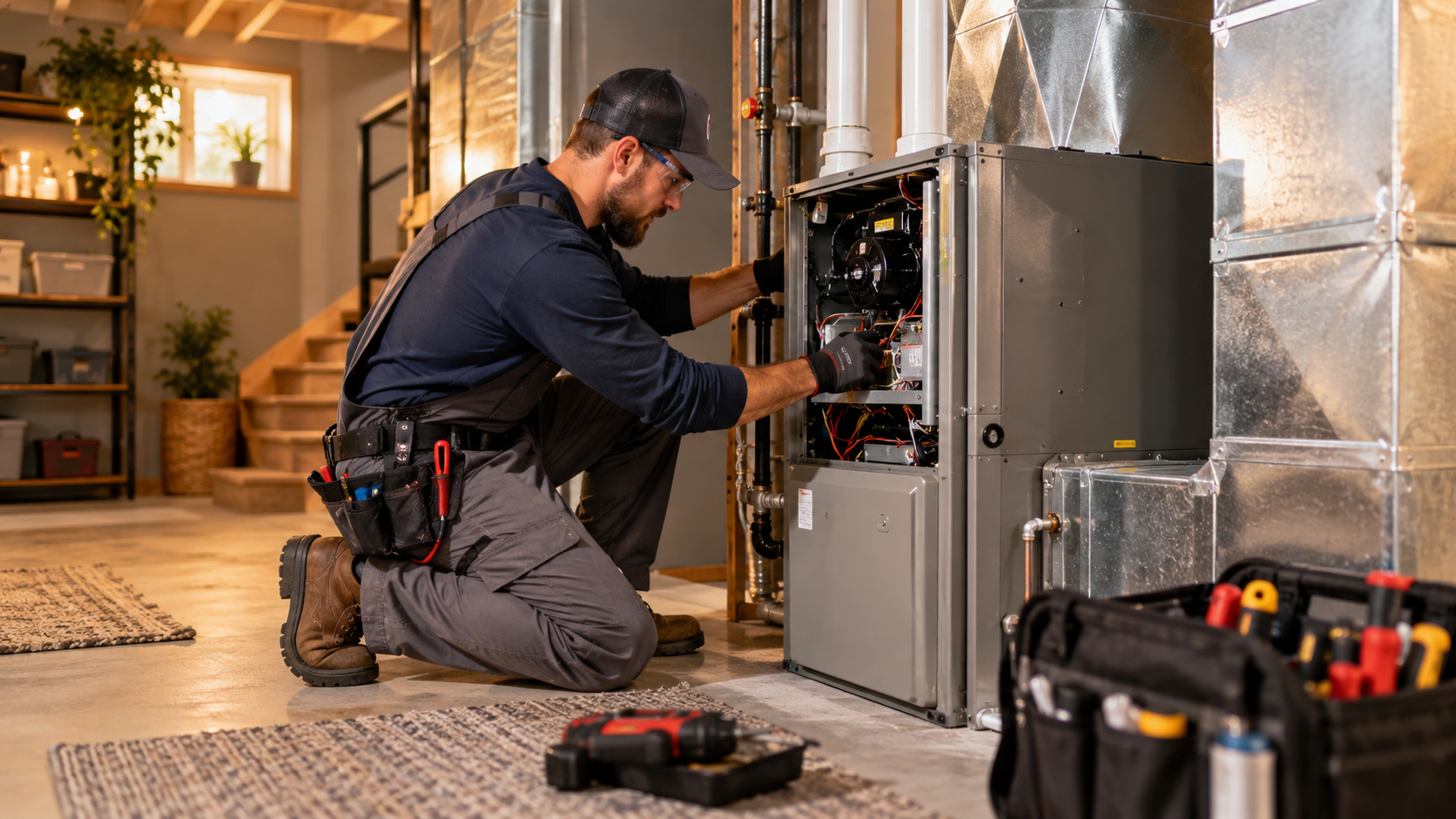
Furnace installation usually starts with a simple thought: the old furnace is done, so just put a new one in its place.
Sounds reasonable. But heating systems are not quite like refrigerators. You cannot always swap one box for another and expect the house to feel better.
The new furnace has to match the home, the duct system, the fuel source, the electrical setup, the venting, and the local climate. A unit that is too large can be annoying and inefficient. One that is too small may struggle through the coldest days of the year.
Then there are practical questions. How efficient should the furnace be? Does the ductwork need work too? Is a permit required? Should you replace the air conditioner at the same time? How much disruption should you expect?
These are normal questions, especially if you have never replaced a heating system before.
Here is the useful way to think about furnace installation: you are not simply buying a furnace. You are putting a new heating system into an existing house.
That small shift in thinking makes almost every decision easier.
How a Furnace Actually Heats a House
A furnace heats air and moves that warm air through ducts into the rooms of the home.
In a typical forced-air system, return ducts bring cooler indoor air back toward the furnace. The furnace heats it, the blower pushes it through the supply ducts, and the cycle repeats until the thermostat reaches its set temperature.
Gas furnaces remain common in many parts of the United States, but homes may also have propane, oil, or electric furnaces depending on the region and available utilities.
The furnace is only one part of that system.
The thermostat tells it when to run. The blower moves air. The ducts distribute that air. Filters protect the equipment and help manage airborne particles. Venting safely carries combustion gases outdoors on fuel-burning systems.
If one part is wrong, the new furnace may not perform the way you expected.
When Does a Furnace Really Need Replacement?
An old furnace is not automatically a bad furnace.
Some older units continue working reliably with regular maintenance. Others reach a point where frequent repairs stop making financial sense.
Age matters, but behavior matters more.
You may want to discuss replacement when the furnace needs repeated repairs, struggles to keep the home comfortable, makes unusual noises, or has major component problems. Rising heating bills can also be a clue, though energy costs, insulation, weather, and thermostat habits can affect bills too.
A cracked heat exchanger on a combustion furnace is a different situation from a worn blower motor. Safety-related problems need immediate attention from a qualified professional.
And sometimes replacement is simply a practical decision. Spending a large amount repairing a very old system can feel like putting an expensive new engine into a car that has several other major problems waiting around the corner.
Do Not Size a Furnace by Looking at the Old One
This is one of the biggest furnace installation issues.
The old furnace is not proof that the home needs the same capacity again.
It may have been oversized when the house was built. The home may now have better windows, added insulation, air sealing, or other changes that reduce heating demand.
Proper sizing starts with the home’s heating load.
HVAC professionals commonly calculate heating needs by considering factors such as floor area, insulation, windows, exterior walls, air leakage, orientation, local winter temperatures, and other building details. In the U.S., contractors often work with established load-calculation methods such as ACCA Manual J.
This is much more useful than guessing from square footage alone.
Why an Oversized Furnace Can Be a Problem
Bigger sounds safer. If a 60,000-BTU furnace works, wouldn’t an 80,000-BTU model heat the house even better?
Not necessarily.
An oversized furnace may raise the temperature quickly and then shut off. A few minutes later, it starts again. This repeated cycling can affect comfort, noise, efficiency, and equipment wear.
Some rooms may feel hot while others still feel cool because the system shuts down before air circulates evenly throughout the house.
A properly sized system tends to run longer, steadier heating cycles.
That often feels better than short bursts of very hot air.
And What Happens If the Furnace Is Too Small?
Going too far in the other direction causes its own problems.
A furnace that lacks enough heating capacity may run for long periods and still fail to maintain the desired temperature during very cold weather.
The goal is not the smallest furnace you can buy.
The goal is the right furnace for the actual heating load.
That distinction matters.
Understanding Furnace Efficiency
Fuel-burning furnaces are commonly rated with AFUE, or Annual Fuel Utilization Efficiency.
AFUE describes how efficiently the equipment converts fuel into useful heat over a typical heating season.
A higher AFUE generally means a greater share of the fuel becomes heat for the home rather than being lost through the venting process.
But efficiency is only part of the financial picture.
A very efficient furnace may cost more upfront. Whether the extra expense makes sense can depend on climate, fuel prices, how long you expect to own the home, and the difference between the models being considered.
| Factor | Why It Matters | Question to Ask |
|---|---|---|
| Heating load | Determines required furnace capacity | Was a load calculation performed? |
| AFUE | Affects fuel efficiency | How much energy might the higher rating save? |
| Blower type | Affects airflow, comfort, and electricity use | Does the system have a variable-speed blower? |
| Ductwork | Controls how heated air reaches rooms | Can the existing ducts handle the new system? |
| Venting | Critical for combustion safety | Does the venting need modification? |
| Thermostat | Controls system operation | Is the current thermostat compatible? |
| Filter setup | Affects airflow and maintenance | What filter size and type should be installed? |
Single-Stage, Two-Stage, and Modulating Furnaces
Not every furnace operates the same way.
A single-stage furnace has a fairly simple setup. When heat is needed, it runs at its full heating output. Then it shuts off when the thermostat is satisfied.
A two-stage furnace can run at a lower output during milder heating demand and increase output when more heat is needed.
Modulating furnaces can adjust heat output across a wider range.
Why does that matter?
Imagine driving through a residential neighborhood with only two pedal positions: completely off or nearly full throttle. You would still reach your destination, but the ride would not be particularly smooth.
Multi-stage and modulating equipment can create longer, gentler heating cycles when conditions allow.
That can improve comfort, though these systems usually cost more and contain more advanced components.
The Blower Matters More Than Most People Expect
The furnace creates heat, but the blower has the job of moving that heat through the house.
Modern systems may have multi-speed or variable-speed blower motors that can adjust airflow based on operating conditions.
A variable-speed blower can sometimes run at lower speeds for longer periods rather than constantly switching between full airflow and nothing.
That can help with temperature consistency and noise.
It can also matter when the same blower is used for central air conditioning.
Before Furnace Installation, Check the Ductwork
A shiny new furnace connected to poor ductwork is a little like installing a powerful new shower head on pipes that barely carry water.
The equipment may be good. The delivery system is still a problem.
Ducts can be undersized, damaged, disconnected, poorly sealed, restricted, or badly designed. Return-air capacity can also be inadequate.
If the existing system has always had rooms that are difficult to heat, mention that before installation begins.
Those comfort problems may not disappear just because the furnace changes.
Ask the contractor to look at airflow rather than assuming every comfort issue comes from the equipment.
Signs the Duct System Deserves Attention
- Some rooms stay noticeably colder than the rest of the home
- Airflow is weak from certain supply vents
- The furnace is loud through the duct system
- Return vents produce strong whistling sounds
- Ducts are visibly damaged or disconnected
- Older flexible ducts are crushed or sharply bent
- Large parts of the duct system run through an attic, crawl space, or garage
- The existing furnace has repeated overheating or airflow problems
Not every duct system needs replacement.
Sometimes a few repairs or adjustments are enough.
The point is simply to check before the new furnace is sized and installed.
Gas Furnace Installation Has Extra Requirements
A gas furnace requires more than a gas connection.
The installer must also consider combustion air, venting, electrical connections, condensate drainage on condensing models, clearances, gas pressure, and safety controls.
Modern high-efficiency condensing furnaces often vent differently from older conventional furnaces.
That means the existing chimney or metal flue may not be reused in the same way.
Venting requirements depend on the equipment and the installation design, so this is not an area for improvisation.
The manufacturer’s installation instructions and applicable local codes matter.
What About Carbon Monoxide?
Any fuel-burning appliance deserves respect because incomplete combustion or venting problems can create carbon monoxide hazards.
A correctly installed furnace should safely vent combustion products outdoors.
Homes with fuel-burning equipment should also have properly located carbon monoxide alarms according to applicable local requirements and manufacturer guidance.
Do not treat a carbon monoxide alarm as a substitute for correct installation or maintenance.
It is another layer of protection.
Where Can a Furnace Be Installed?
Furnaces are commonly found in basements, utility rooms, closets, attics, garages, and crawl spaces.
The location affects installation difficulty and service access.
A spacious basement installation is usually easier to work around than a furnace squeezed into a low attic above a finished ceiling.
Access matters long after installation day too.
Technicians need room to replace filters, remove panels, test components, clean the system, and make future repairs.
An installation that technically fits but leaves almost no service space can become frustrating later.
What Happens During a Typical Furnace Installation?
The details vary, but the job usually follows a recognizable sequence.
First, the existing system is shut down safely. Fuel and electrical connections are disconnected as needed, and the old furnace is removed.
The installation area may then require preparation or modification.
The new furnace is positioned and connected to the duct system. Fuel, electrical, venting, drainage, thermostat wiring, and other required components are installed or adjusted.
But the installer should not simply turn it on and leave.
The system needs startup testing.
Airflow, temperature rise, gas operation, venting, safety controls, and thermostat operation may need to be checked according to the equipment and system type.
Proper commissioning is one of the least glamorous parts of furnace installation and one of the most important.
What Homeowners Should Expect on Installation Day
Installation can take several hours, while more involved projects may take longer.
Changing fuel type, modifying ducts, replacing venting, moving equipment, adding electrical work, or dealing with a difficult attic can extend the job.
Before the crew arrives, it helps to clear a path to the furnace and remove stored items around the work area.
Keep pets away from open doors, tools, and the equipment area.
And expect the heat to be unavailable for part of the day.
If installation is happening during very cold weather, ask how long the home is likely to be without heat.
Permits and Inspections
Permit requirements vary across the United States.
Many jurisdictions require permits for furnace replacement or installation, particularly when gas, electrical, venting, or mechanical work is involved.
An inspection may also be required after the work is completed.
Do not assume a project is too small for permits just because the furnace is going into the same general location.
Ask the contractor who handles the permit and whether it is included in the estimate.
How Much Does Furnace Installation Cost?
There is no single useful national price because furnace installation can mean very different things from one house to another.
A straightforward replacement using compatible existing ducts and utilities is one type of project.
Moving the furnace, upgrading venting, repairing ducts, modifying gas lines, adding electrical work, or replacing the air conditioner at the same time is another.
| Cost Factor | How It Can Affect the Project |
|---|---|
| Furnace capacity | Larger equipment may cost more |
| Efficiency rating | Higher-efficiency models may carry a higher initial price |
| Single-stage vs. advanced equipment | Two-stage and modulating systems are usually more expensive |
| Installation location | Attic or tight-space work can require more labor |
| Duct modifications | Repairs or resizing add labor and materials |
| Venting changes | High-efficiency equipment may require a different venting setup |
| Gas or electrical work | Utility modifications can increase project scope |
| Permits | Local permit and inspection fees vary |
| Thermostat replacement | New controls add equipment and setup costs |
| Removal of old equipment | Disposal may be included or listed separately |
When comparing bids, compare scope rather than looking only at the bottom-line number.
One estimate may include permit fees, thermostat work, duct transitions, removal, startup testing, and warranty registration.
Another may not.
A price difference makes more sense once you know what is actually included.
Should You Replace the Air Conditioner at the Same Time?
Not always.
If the air conditioner is relatively new and compatible with the new furnace, replacing it may make little sense.
But if both systems are old, the situation deserves a closer look.
Central air conditioners and furnaces often share a blower and indoor equipment area. Coordinating both replacements can sometimes reduce duplicated labor and avoid compatibility problems later.
This does not mean you should automatically replace working cooling equipment.
Ask how old it is, what condition it is in, and whether the new furnace changes anything about the existing setup.
Do You Need a New Thermostat?
Maybe.
A basic furnace may work perfectly well with an existing compatible thermostat.
More advanced staged or communicating systems may need different controls to access all their features.
Smart thermostats can add scheduling, remote access, energy reports, and other conveniences, but compatibility still matters.
Do not assume any thermostat works with every HVAC system.
Should Furnace Installation Include a New Filter Setup?
This is a small detail that can matter for years.
Ask where the filter will go, what size it is, and how easy it will be to replace.
Some older systems have awkward filter racks that leak air or require unusual filter sizes.
Installation day can be a good time to improve that setup.
Also remember that a higher-rated filter is not automatically better for every system.
Filters create resistance to airflow. The furnace and duct system need to handle the selected filter properly.
Furnace Installation Mistakes Worth Avoiding
Most homeowners are not expected to supervise technical HVAC work.
Still, knowing the common trouble spots can help you ask better questions.
- Replacing the furnace with the same size without checking the home’s heating load
- Ignoring weak or damaged ductwork
- Installing equipment that is difficult to service later
- Skipping required permits
- Using incompatible venting
- Failing to provide proper condensate drainage on equipment that produces condensate
- Installing an overly restrictive filter setup
- Ignoring thermostat compatibility
- Failing to test the system after startup
- Assuming every comfort problem will disappear with new equipment
The last one deserves emphasis.
If an upstairs bedroom has been cold for fifteen years, a new furnace may not magically fix it.
The underlying problem could be airflow, insulation, duct design, windows, or air leakage.
How to Compare Furnace Installation Quotes
Three contractors can recommend three different furnaces and all sound confident.
That can make comparison confusing.
Start with the basics.
Do the proposed systems have similar heating capacity? Similar efficiency? Similar staging? Does each quote include the same ductwork, venting, thermostat, permits, disposal, and labor?
Then ask how the capacity was determined.
A clear explanation is more reassuring than “This is what we always install in houses this size.”
Also look at labor and warranty details.
A furnace is a manufactured product, but the installation is custom work inside your home.
The quality of that work matters.
What Questions Should You Ask the Contractor?
You do not need twenty pages of technical questions.
A handful of practical ones can reveal a lot.
Ask how the furnace was sized. Ask whether existing ducts are adequate. Ask if venting needs changes. Ask who handles permits. Ask what is included in startup testing.
And ask what you will need to do as the homeowner after installation.
You should leave the project knowing where the filter is, how often it should be checked, what thermostat settings are recommended, and who to call if something seems wrong.
How Long Should a New Furnace Last?
There is no guaranteed lifespan.
Equipment quality matters, but installation quality, maintenance, operating conditions, climate, usage, and airflow all influence how long a furnace lasts.
A well-installed furnace that receives reasonable maintenance has a better chance of a long service life than the same model operating with poor airflow and years of neglected filters.
That is why installation day is only the beginning.
Maintenance Starts With Something Very Simple
Check the filter.
Seriously. It sounds almost too basic, but restricted airflow can make the system work harder and can contribute to operating problems.
How often a filter needs attention depends on the filter, home, pets, indoor conditions, and system usage.
Some filters need frequent replacement. Larger media filters may last much longer.
Follow the equipment and filter recommendations rather than relying on one universal schedule.
What About Heat Pumps Instead of a Furnace?
If you are replacing a furnace today, it can be worth asking whether a heat pump is practical for your home.
Modern heat pumps can heat and cool a home with one system, and cold-climate models have expanded where heat pumps can be considered.
That does not mean a heat pump is automatically the right answer everywhere.
Climate, electricity rates, gas prices, electrical capacity, ductwork, incentives, comfort preferences, and the home’s heating load all matter.
Some households also consider dual-fuel systems that combine a heat pump with a furnace.
If you are already spending money on major HVAC replacement, asking about alternatives costs nothing.
Does a High-Efficiency Furnace Always Save More Money?
It saves fuel compared with a less efficient furnace under comparable operating conditions.
But the financial payback depends on the price difference and how much heating the home actually needs.
A homeowner in a very cold climate who uses large amounts of natural gas may see the economics differently from someone living in a mild region where the furnace runs only occasionally.
Comfort features can matter too.
You may value quieter operation, staged heating, or better airflow even if the decision is not based purely on fuel savings.
Should You Install the Furnace Yourself?
For most homeowners, furnace installation is not a casual DIY project.
Fuel-burning equipment involves combustion, gas connections, venting, electrical work, airflow setup, safety controls, and local code requirements.
Mistakes can create fire, gas, electrical, or carbon monoxide hazards.
Even electric furnace installations involve high-voltage electrical systems and substantial electrical loads.
This is one of those home projects where professional installation usually makes sense.
What a Good Furnace Installation Should Feel Like
You should not have to think much about your furnace once the installation is complete.
The home should warm steadily.
The equipment should start and stop normally. Airflow should feel reasonable. The thermostat should control the system correctly. You should not smell gas, hear alarming mechanical noises, or see water where it should not be.
The best heating system is a bit boring.
You set the thermostat, the house gets warm, and you forget about it.
FAQ About Furnace Installation
How long does furnace installation usually take?
A straightforward furnace replacement can often be completed within a working day, but more involved projects may take longer. Duct changes, venting work, electrical modifications, difficult access, or relocation of equipment can extend the schedule.
Do I need a permit for furnace installation?
Permit rules vary by city, county, and state. Many U.S. jurisdictions require permits for furnace replacement or related gas, electrical, and mechanical work. Ask the contractor what applies locally and who will handle the paperwork.
How do I know what size furnace I need?
The most reliable approach is a proper heating-load calculation based on the house, climate, insulation, windows, air leakage, and other building details. Square footage alone does not tell the whole story.
Is a higher AFUE furnace always better?
A higher AFUE rating means greater fuel efficiency, but the most sensible option depends on climate, fuel costs, installation price, equipment features, and how long you expect to use the system.
Can a new furnace use my existing ductwork?
Often yes, but the ducts should be checked for sizing, condition, leakage, and airflow. Existing comfort problems may continue if the duct system is the real issue.
Should I replace my thermostat when replacing the furnace?
Not necessarily. An existing thermostat may work with the new furnace, but staged, variable, or communicating systems may require different controls for full operation.
Can furnace installation improve uneven room temperatures?
Sometimes. Proper sizing and airflow can help, but uneven temperatures may also come from duct design, insulation, windows, air leakage, or inadequate return airflow. Those issues may need separate attention.
Conclusion: A Furnace Is Only as Good as the Installation
Shopping for a furnace can feel like shopping for a box full of specifications.
BTUs. AFUE. Stages. Blower motors. Thermostats.
Those numbers matter.
But furnace installation matters just as much.
A premium furnace that is oversized, connected to weak ducts, poorly vented, or never properly tested can create more frustration than a simpler model installed correctly.
Start with the house.
How much heat does it actually need?
How well does the current duct system move air?
Are there rooms that have always been uncomfortable?
Does the venting need to change?
Are the thermostat and electrical setup compatible?
Once those questions are answered, the furnace itself becomes much easier to evaluate.
And do not let the conversation stop at efficiency ratings.
A furnace can have an impressive AFUE number and still be the wrong system for the home.
Comfort depends on capacity, airflow, equipment controls, ductwork, building insulation, and installation quality working together.
Think about service access too.
The furnace will need filters, maintenance, and probably a repair at some point during its life. An installation that leaves technicians room to work can save frustration later.
The same goes for documentation.
Keep the equipment model and serial numbers, installation invoice, warranty information, permit records, and contractor contact details somewhere easy to find.
You may not need them for years.
Then one cold January morning, you will be very glad you know where they are.
Before signing an estimate, read what is actually included.
Does the price include removal of the old unit?
Does it include the permit?
What about venting changes?
Is a thermostat included?
Are duct transitions part of the quote?
What startup tests will be performed?
What happens if the installer discovers another issue after removing the old furnace?
Simple questions prevent a lot of misunderstandings.
Also, pay attention when a contractor talks about sizing.
If the explanation is based only on your old furnace or one quick glance at the house, ask how the heating requirement was determined.
A replacement project is a good opportunity to correct old sizing mistakes instead of copying them for another fifteen or twenty years.
And if the house has comfort problems now, say so before the installation begins.
Do not wait until the new system is running to mention that the bedroom above the garage has always been freezing.
That detail may point to a duct, insulation, or airflow problem that deserves attention while the system is being evaluated.
Furnace installation is also a good moment to think a little further ahead.
If your air conditioner is also aging, ask about its condition and compatibility.
If you have been curious about heat pumps, ask whether one makes sense for the home.
If your electrical panel is already near capacity, mention it when discussing electric heating options.
You do not have to change your entire HVAC plan.
But this is the time to understand what the alternatives look like.
After installation, ask the technician to walk you through the system.
Find the filter.
Learn how to remove it.
Check which direction it should face.
Understand the thermostat.
Know what normal operating sounds are.
Ask whether condensate drainage needs occasional attention.
And know where the furnace shutoff is located.
That five-minute walkthrough can be more useful than a stack of brochures.
Then keep maintenance simple.
Do not block supply or return vents with furniture.
Check filters regularly.
Pay attention to unusual sounds and smells.
And arrange appropriate professional service when needed.
If a carbon monoxide alarm activates, do not assume the furnace is harmless because it appears to be running normally. Follow the alarm manufacturer’s safety guidance and contact appropriate emergency or qualified service professionals.
The same common sense applies to a gas smell.
Do not search around the furnace with a lighter or try to diagnose a suspected gas leak yourself.
Leave the area as appropriate and contact the gas utility or emergency services according to local safety guidance.
Most furnace installations will never lead to that kind of situation.
Still, heating equipment deserves proper installation because the consequences of getting combustion and venting wrong are more serious than simply having a chilly living room.
So when it is time for furnace installation, look beyond the brand name printed on the cabinet.
Look at the house.
Look at the ducts.
Look at the load calculation.
Look at the installation plan.
Then look at the furnace.
That order may feel backwards when you are excited about buying new equipment, but it is usually the smarter way to approach the project.
A furnace should fit the home, not force the home to fit the furnace.
Get that part right, and the reward is wonderfully uneventful: a warm house, steady comfort, reasonable energy use, and a heating system you barely have to think about.

Leave a Reply