
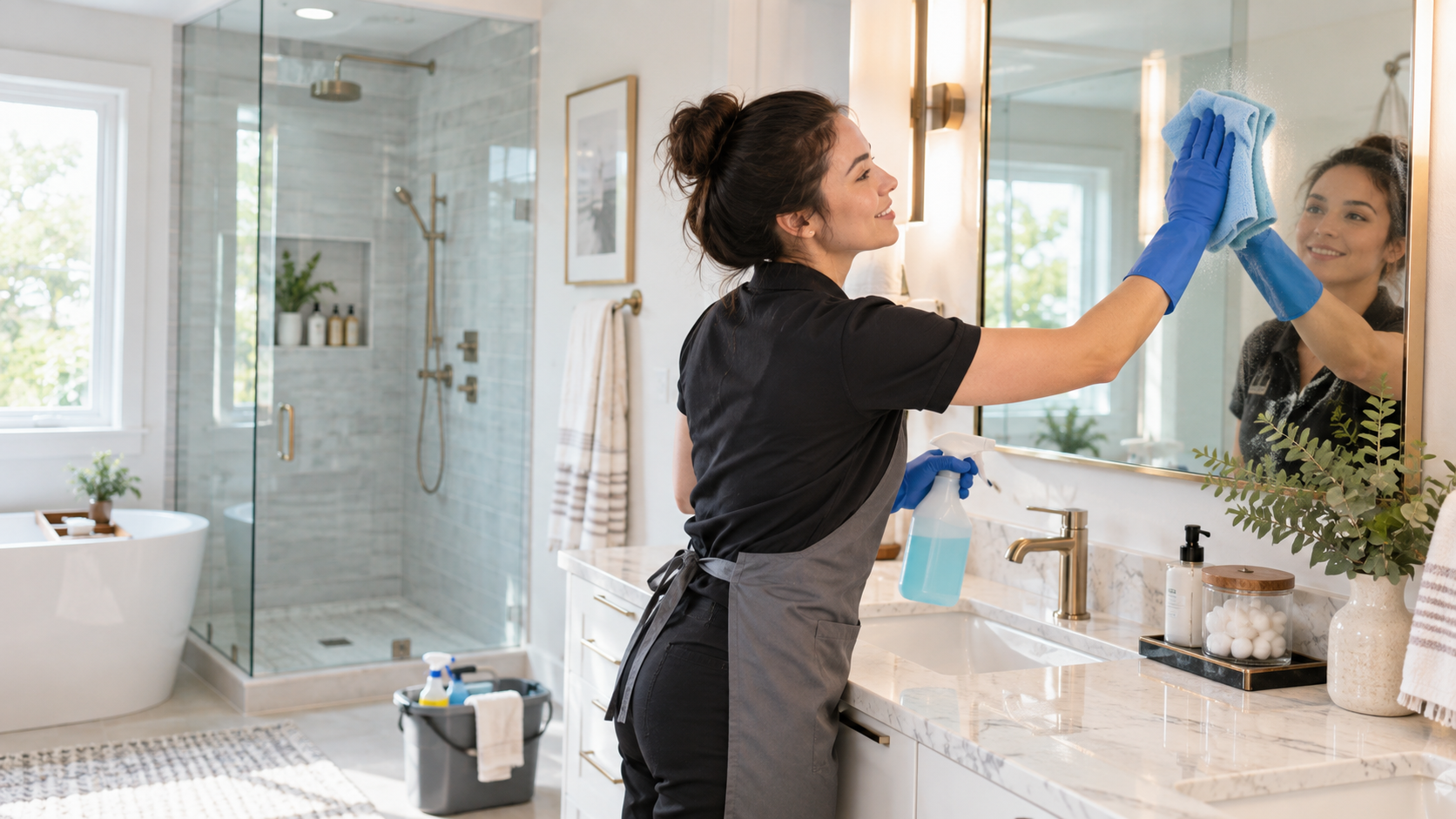
A bathroom can look clean and still not feel clean.
You wipe the mirror. You rinse the sink. You run a mop across the floor. Twenty minutes later, the room looks better, but the shower door still has cloudy spots, the grout looks tired, and there is a suspicious line of dust behind the toilet.
That is where a professional bathroom cleaning service starts to make sense.
It is not simply someone spraying cleaner on the sink and calling it a day. A good service works through the room in a more systematic way. Fixtures, tile, toilets, tubs, showers, mirrors, floors, edges, corners, and frequently touched surfaces all get attention.
For busy households, the biggest benefit is obvious: time. Bathrooms take patience. Soap film does not always disappear after one wipe, and hard-water marks can turn a quick Saturday chore into an hour-long project.
But there is another benefit too. Regular detailed cleaning keeps buildup from reaching the point where everything feels harder to maintain.
That matters in American homes where one bathroom may be shared by several people every morning. Toothpaste, hair products, makeup, damp towels, shower steam, and mineral deposits pile up surprisingly fast.
A bathroom cleaning service handles that routine mess before it becomes the kind of mess nobody wants to deal with.
What Does a Bathroom Cleaning Service Usually Include?
The exact checklist depends on the company and the type of appointment.
A basic recurring visit may focus on visible surfaces and sanitation. A deep-clean appointment normally goes further into edges, buildup, fixtures, baseboards, and areas that are easy to ignore during everyday cleaning.
A typical service may cover the following:
- Cleaning and sanitizing the toilet, including the seat, lid, bowl, tank exterior, and surrounding area
- Wiping sinks, faucets, countertops, and backsplashes
- Cleaning mirrors and other glass surfaces
- Scrubbing the tub or shower area
- Removing surface soap film from tile and shower walls
- Wiping cabinet fronts and drawer handles
- Dusting shelves, trim, vents, and reachable light fixtures
- Cleaning door handles and other frequently touched areas
- Vacuuming or sweeping the floor before mopping
- Removing trash and replacing liners when supplies are available
Some companies also include limited grout scrubbing, shower-door detailing, or spot cleaning on walls.
Others treat those as add-on services.
This is why the service description matters more than the phrase “bathroom cleaning.” Two companies may use the same term while offering very different levels of detail.
Routine Cleaning and Deep Cleaning Are Not the Same Thing
This distinction catches a lot of people off guard.
A recurring bathroom cleaning service usually assumes the room is already in reasonably normal condition. The goal is maintenance: remove fresh dirt, sanitize surfaces, clean fixtures, and stop buildup from getting out of hand.
A deep clean deals with the stuff that has had time to settle in.
Think heavy soap film around the tub, dust along baseboards, cloudy shower glass, grime around fixtures, dirty grout lines, or buildup behind the toilet.
Deep cleaning normally takes longer because cleaners have to spend more time on individual surfaces.
| Cleaning Task | Routine Service | Deep Cleaning |
|---|---|---|
| Sink and countertop | Cleaned and wiped | Detailed around fixtures and edges |
| Toilet | Cleaned and sanitized | Detailed around base, hinges, and hard-to-reach areas |
| Shower walls | General surface cleaning | More attention to soap film and buildup |
| Shower glass | Wiped | Detailed for water spots where practical |
| Baseboards | May be dusted | Usually cleaned more thoroughly |
| Cabinet fronts | Quick wipe | Detailed around handles and edges |
| Floor edges | Standard mopping | Closer attention to corners and perimeter |
| Grout | Surface cleaning | May receive additional scrubbing |
If a bathroom has not had a thorough clean in months, booking a deep clean first usually makes more sense than starting with basic recurring maintenance.
After that, regular service becomes much easier.
Why Bathrooms Get Dirty So Fast
Bathrooms have a pretty unfair job.
They deal with water, steam, skin oils, hair, cosmetics, soap, toothpaste, shaving products, toilet residue, and constant foot traffic. Then the room often stays closed for hours with moisture hanging in the air.
That combination helps soap scum, mineral deposits, and grime stick to surfaces.
Hard water makes the situation more noticeable. Minerals left behind when water evaporates can create pale spots or chalky buildup on glass, chrome, tile, and faucets.
The shower is usually the main trouble zone.
Soap mixes with body oils and minerals in the water. The resulting film clings to walls and doors. Leave it there long enough and what looked like a faint haze can become surprisingly stubborn.
Then there is hair.
One strand is nothing. Fifty strands around a drain, along the base of a vanity, and behind the toilet somehow look like a completely different situation.
This is why bathrooms often benefit from frequent light cleaning rather than occasional heroic cleaning sessions.
What Professional Cleaners Do Differently
A professional cleaner is not performing magic. The difference is usually process, repetition, tools, and time spent on the right areas.
Someone who cleans bathrooms every day knows where grime normally hides.
They look around faucet bases. They check the line where the tub meets the wall. They notice dust on the top edge of the toilet tank. They clean around hardware instead of simply wiping the center of a surface.
Professionals also tend to work in an order that prevents them from cleaning the same area twice.
For example, dusting higher surfaces before cleaning the floor keeps loose dirt from falling onto a freshly mopped area.
Small details like that add up.
The Shower Is Usually the Hardest Part
If you have ever cleaned a glass shower enclosure, you already know this.
The shower collects almost everything bathrooms are good at producing: moisture, soap film, hard-water deposits, shampoo residue, hair, and grime around seals and tracks.
Tile showers add grout to the equation.
Grout is porous unless properly sealed, so dirt and moisture can settle into the surface more easily than on smooth tile.
That does not mean every dark grout line can simply be scrubbed back to brand-new condition. Discoloration may be deep, permanent, or related to aging material.
A reputable cleaner should be realistic about that.
Cleaning can remove surface dirt. It cannot repair damaged grout, failing caulk, etched glass, cracked tile, or permanent mineral damage.
What About Mold and Mildew?
Bathrooms naturally create humid conditions, so mildew can appear around tubs, showers, ceilings, window areas, and caulk.
Small surface spots may sometimes be handled during ordinary cleaning, depending on company policy.
But widespread or recurring mold is a different issue.
If the same area keeps returning after cleaning, moisture may be getting trapped because of poor ventilation, plumbing leaks, damaged grout, failing caulk, or another building problem.
Cleaning the surface over and over will not correct a moisture source.
Large or suspicious mold problems may need assessment beyond a normal house-cleaning appointment.
That distinction is important. A bathroom cleaning service maintains surfaces. It is not the same as professional mold remediation.
How Often Should a Bathroom Be Professionally Cleaned?
There is no one schedule that fits every household.
A guest bathroom used twice a month obviously does not need the same routine as the only bathroom shared by four people.
Many households that hire cleaners schedule weekly, every-other-week, or monthly visits.
Weekly service can make sense for larger households, high-use bathrooms, or people who simply do not want bathroom cleaning on their weekend list.
Every-other-week appointments are a common middle ground. The room receives regular attention without bringing cleaners in every few days.
Monthly service can work well when homeowners handle light maintenance themselves between visits.
The right rhythm depends on:
- How many people use the bathroom
- Whether children share the space
- How often the shower or tub is used
- Whether the home has hard water
- How quickly dust and hair accumulate
- Whether pets enter the bathroom
- How much cleaning the household does between appointments
- Whether the bathroom has good ventilation
If you are unsure, start with one deep clean and see how long the bathroom stays comfortable afterward.
That gives you a much better idea of the schedule your home needs.
What Affects Bathroom Cleaning Service Prices?
Pricing varies widely across the United States.
Labor costs differ by city. Bathroom size differs. Condition matters. A quick maintenance clean of a small half bath is not the same job as restoring order to a large primary bathroom with a soaking tub, double vanity, glass shower, tile floor, and separate toilet area.
This is why a low advertised starting price may not tell you much about the final bill.
| Price Factor | Why It Matters |
|---|---|
| Bathroom size | Larger rooms require more surface cleaning and floor work |
| Number of fixtures | Double vanities, large tubs, and multiple shower areas add time |
| Current condition | Heavy buildup usually takes longer than routine maintenance |
| Type of service | Deep cleaning normally costs more than recurring cleaning |
| Shower design | Glass panels, tracks, tile, and grout can add detail work |
| Frequency | Recurring visits may be priced differently from one-time service |
| Location | Labor and operating costs vary across U.S. markets |
| Add-on requests | Special tasks may be billed separately |
When asking for a quote, describe the room accurately.
If the shower has heavy hard-water buildup, say so.
If the bathroom has not been cleaned properly in six months, mention that too.
A realistic description helps the company estimate the job more accurately and reduces awkward surprises on cleaning day.
Whole-House Cleaning or Bathroom-Only Service?
Many cleaning companies focus on full-home appointments.
They clean kitchens, bedrooms, living spaces, and bathrooms during the same visit.
But some companies also offer targeted bathroom cleaning service appointments.
This can be handy before guests arrive, after tenants move out, after renovation dust settles, or when the bathroom simply needs more work than the rest of the house.
For a household that generally keeps up with cleaning but hates scrubbing showers, bathroom-only service can also be a practical compromise.
When a One-Time Deep Clean Makes Sense
You do not need a recurring cleaning contract to hire help.
A one-time deep clean can be useful when the bathroom has slowly reached the “I do not even know where to start” stage.
It is also useful before special events.
Maybe family is coming for Thanksgiving. Maybe friends are staying for a weekend. Maybe you are putting the house on the market and suddenly noticing every water spot you somehow ignored for three years.
A detailed cleaning appointment can reset the room.
After that, normal maintenance feels much less intimidating.
How to Prepare Before the Cleaner Arrives
You do not need to clean the bathroom before someone comes to clean it.
That would defeat the point.
But clearing personal items can save time.
If the vanity is buried under toothbrushes, cosmetics, hair tools, medication bottles, and ten half-empty skincare products, the cleaner has to work around everything.
Moving small personal items gives better access to countertops and shelves.
Before the appointment, it helps to:
- Remove clothing and towels from the floor
- Put toiletries into drawers, baskets, or cabinets
- Clear the shower floor of bottles when practical
- Secure medications, jewelry, cash, and other valuables
- Tell the company about fragile fixtures or delicate surfaces
- Keep pets away from the work area
- Provide access instructions if you will not be home
- Point out any areas that need special attention
That is enough.
The goal is not to make the bathroom look perfect before the professional arrives. Just make the surfaces accessible.
Do You Need to Supply Cleaning Products?
Usually not.
Professional cleaning companies commonly bring their own products and tools.
But policies vary.
If you prefer fragrance-free products, environmentally focused cleaners, or a specific product for natural stone, tell the company in advance.
This matters especially with marble, travertine, limestone, specialty tile, coated fixtures, or other surfaces that may react badly to acidic or abrasive products.
Never assume every bathroom surface can handle the same cleaner.
What works perfectly on ceramic tile may be a terrible idea on natural stone.
Cleaning Is Not the Same as Disinfecting
These words often get thrown around as though they mean exactly the same thing.
They do not.
Cleaning removes dirt, residue, and organic material from a surface.
Disinfecting uses an appropriate product to reduce certain microorganisms according to that product’s instructions.
Many disinfectants require a surface to remain visibly wet for a specified contact time. Spraying something and wiping it away instantly may not provide the disinfecting effect listed on the product label.
A good cleaning service should follow product instructions rather than treating stronger chemical smells as proof of a better clean.
Why Stronger Chemicals Are Not Always Better
Bathroom grime can tempt people into chemical warfare.
If one cleaner does not work, grab something stronger. Then something stronger again.
That approach can damage fixtures and surfaces.
Abrasive products can scratch some finishes. Acidic products can damage certain stone. Harsh chemicals may discolor metal or degrade sealants.
And household chemicals should never be mixed casually.
In particular, products containing bleach should not be mixed with ammonia or acids because dangerous gases can form.
Professional cleaning should be controlled, not aggressive.
Can a Cleaning Service Remove Hard-Water Spots?
Often they can improve them significantly.
Fresh mineral deposits may respond well to proper cleaning.
Older deposits can be more stubborn.
In some cases, minerals can etch glass or damage finishes over time. Once a surface is physically altered, cleaning alone cannot fully restore it.
If shower glass still looks cloudy after detailed cleaning, permanent etching may be part of the issue.
That is worth knowing before paying repeatedly for someone to attack a problem that is no longer just dirt.
What About Grout Cleaning?
Grout deserves its own conversation.
Light surface grime can often be cleaned during normal bathroom service.
Heavily discolored grout may require more concentrated work, and some companies offer specialized grout cleaning separately.
Even then, grout does not always return to its original color.
Years of staining, damaged sealant, mildew, or material aging can change its appearance permanently.
In those cases, regrouting, repairing, or recoloring may be more realistic than endless scrubbing.
What a Bathroom Cleaner Cannot Fix
A cleaner can make surfaces cleaner.
They cannot repair a leaking shower valve.
They cannot fix cracked grout, loose tile, damaged caulk, failing ventilation, clogged plumbing deep inside a drain line, or water leaking behind a wall.
This matters because dirt sometimes hides maintenance problems.
Once the bathroom is cleaned properly, you may suddenly notice a cracked seal, damaged fixture, or slow leak that was harder to see before.
That is not a cleaning failure.
It is actually useful information.
Should You Be Home During the Appointment?
You can be, but you usually do not have to be.
Many homeowners provide entry through a smart lock, lockbox, building concierge, or another agreed method.
If it is your first appointment, being home for the beginning can help.
You can show the cleaner the bathroom, point out delicate surfaces, explain priorities, and answer questions.
After that, recurring visits often become straightforward.
How Long Does Bathroom Cleaning Take?
There is no universal answer.
A small powder room in good condition might be fairly quick.
A large primary bathroom with two sinks, a bathtub, a walk-in shower, tile, glass, mirrors, and heavy buildup is a completely different project.
Deep cleaning takes longer than maintenance cleaning.
That is normal.
Be cautious with expectations that promise a heavily soiled bathroom will look perfect after a very short visit. Thorough work takes time.
How to Tell Whether the Service Was Done Well
You should not need a white glove and magnifying glass.
Look at the obvious things first.
The toilet should be clean. The sink should not have toothpaste residue. Mirrors should look clear. Fixtures should not feel greasy. Hair should not be sitting in floor corners.
Then look at the places people often miss.
Check around the toilet base. Look at faucet edges. Check the shower corners and the area where the tub meets the wall.
A detailed service should feel consistent throughout the room.
Recurring Service Can Be Easier Than Occasional Rescue Cleaning
There is a funny thing about cleaning.
Waiting longer rarely makes the job easier.
Regular visits prevent heavy soap film, dust, hair, and mineral residue from accumulating to the same degree.
That can make each appointment faster and more predictable.
It also keeps the bathroom closer to that “just cleaned” state instead of bouncing between spotless and disaster zone.
Bathroom Cleaning Service for Rental Properties
Bathrooms matter a lot during move-in and move-out cleaning.
Tenants notice toilets, tubs, sinks, and showers immediately.
A bathroom that looks grimy can make the entire property feel dirty even when the rest of the home is in decent condition.
Landlords and property managers often need a more detailed cleaning between occupants because the next person expects the room to feel fresh from day one.
Move-out cleaning may therefore include more attention to cabinets, drawers, fixtures, baseboards, and areas that routine tenant cleaning skipped.
Bathroom Cleaning Before Selling a Home
Bathrooms also get extra attention from buyers.
A bright, clean bathroom photographs better and feels better during a showing.
You do not need a luxury renovation for the room to make a good impression.
Clean glass, polished fixtures, fresh-looking grout, uncluttered counters, and a spotless toilet can change the entire feeling of the space.
Cleaning is one of the lower-cost things a seller can do before listing.
How to Compare Bathroom Cleaning Companies
Price matters, but it should not be the only question.
Ask what the service actually includes.
Find out whether the company is insured. Ask how cleaners gain access to homes and what happens if something is damaged.
If you have natural stone or specialty finishes, mention them before booking.
And pay attention to communication.
A company that answers basic questions clearly before the appointment is easier to work with if something comes up later.
Is Professional Bathroom Cleaning Worth It?
For some people, absolutely.
For others, not necessarily.
If you enjoy cleaning and have time for it, paying someone else may feel unnecessary.
But if weekends already disappear into groceries, laundry, errands, kids, work, and trying to have some kind of life, cleaning the shower may be the task you are very happy to hand over.
The value is not only the clean bathroom.
It is the time you get back.
There is also value in consistency. A recurring cleaner helps prevent that slow slide where the bathroom looks fine one week, questionable the next, and suddenly requires an entire afternoon.
FAQ About Bathroom Cleaning Service
What is included in a bathroom cleaning service?
Most services clean toilets, sinks, countertops, mirrors, tubs or showers, fixtures, floors, and common touch points. Deep cleaning may add more detailed work around grout, baseboards, shower glass, edges, and buildup.
How much does bathroom cleaning service cost?
Prices vary by location, bathroom size, condition, service type, and company. A large bathroom needing deep cleaning will usually cost more than a small bathroom receiving regular maintenance.
How often should I book professional bathroom cleaning?
Weekly, every-other-week, and monthly schedules are common. The right timing depends on household size, bathroom use, hard-water conditions, pets, and how much cleaning you do between visits.
Can professional cleaners remove hard-water stains?
Many mineral deposits can be reduced or removed, especially when they are relatively fresh. Older deposits may permanently etch glass or damage finishes, so cleaning may not restore every surface completely.
Do bathroom cleaners clean grout?
Basic surface cleaning may be included, while heavy grout scrubbing can be treated as a deep-clean or specialty service. Ask before booking if grout is one of your main concerns.
Do I need to provide cleaning products?
Usually not. Many professional services bring their own tools and supplies. Tell the company in advance if you need fragrance-free products or have delicate materials such as natural stone.
Should I clean before the professional arrives?
No. Just remove clutter when possible. Clearing towels, toiletries, clothing, and personal items gives the cleaner better access to the surfaces they are there to clean.
Conclusion: A Cleaner Bathroom Without Losing Your Saturday
Bathroom cleaning is one of those chores that looks small until you actually start doing it.
The sink takes five minutes.
Then you notice the faucet.
Then the mirror.
Then the shower glass.
Then the grout.
And somehow your quick cleanup has turned into a full afternoon.
A bathroom cleaning service takes that job off your list and handles it with a more consistent routine.
The service can be especially useful for busy families, older adults, rental properties, people preparing a home for sale, or anyone who simply has better things to do than spend Sunday morning scrubbing a shower door.
The key is knowing what you are booking.
Routine cleaning and deep cleaning are different services. Heavy mineral buildup may need more time. Damaged grout, mold caused by hidden moisture, cracked caulk, and plumbing problems cannot be solved by cleaning alone.
Good companies should be clear about those limits.
Before scheduling an appointment, look at the bathroom honestly.
Is it basically clean but needs regular upkeep?
Or has buildup been accumulating for months?
If the second description sounds more accurate, start with a deep clean.
Once the room has been reset, maintenance gets much easier.
Also think about what matters most to you.
Maybe it is the shower glass.
Maybe it is grout.
Maybe you just never want to clean the area behind the toilet again.
Tell the cleaner.
Clear expectations help everyone.
And if you are comparing services, do not look only at price.
Look at what is included, how the company communicates, whether it understands your surfaces, and whether it has realistic expectations about old stains and damaged materials.
The cheapest appointment is not always the cheapest if important tasks are excluded and later added as extras.
Regular professional cleaning can also make your own quick cleanups easier.
When soap film never gets a chance to become thick, wiping the shower takes less effort. When floors are cleaned consistently, dust and hair do not accumulate in the corners. When fixtures receive regular attention, mineral residue has less time to settle.
That is the real advantage of maintenance.
Nothing gets dramatic.
The bathroom simply stays cleaner.
And sometimes that is exactly what you want from a home service.
No huge project. No big renovation. No weekend lost to scrubbing.
Just a bathroom that feels fresh when you walk in.






Leave a Reply