
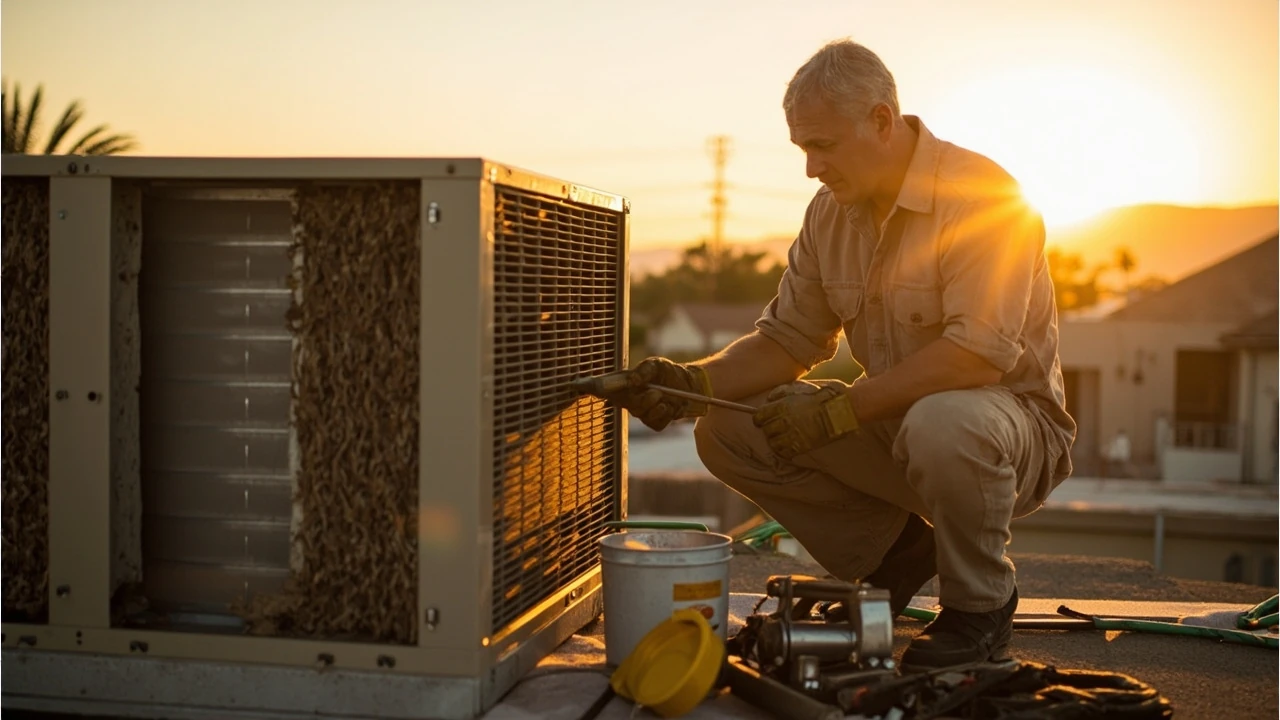
Swamp cooler repair: a homeowner’s guide
It is 7:30 a.m., already 88 degrees, and the air coming out of the duct smells faintly of mildew. The pads were replaced last summer, the pump was working yesterday, and now the bedroom feels warmer than the yard. This is the moment most homeowners start thinking seriously about swamp cooler repair, because an evaporative cooler rarely fails all at once. It usually loses capacity gradually, throws one obvious symptom, and then tips over the edge when the first heat wave arrives.
Swamp coolers, also called evaporative coolers, are simple machines compared with central air conditioning, which is why a careful homeowner can diagnose and fix many of their problems. They move air with a blower, distribute water over a pad, and rely on evaporation to drop the temperature. That simplicity is also a weakness: more parts are exposed to water, dust, and mineral scale, so the unit needs regular attention. This guide walks through how to recognize common problems, which fixes are realistic on a Saturday morning, and when a swamp cooler repair is really a job for a licensed technician.
How an evaporative cooler actually works
Before troubleshooting any swamp cooler, it helps to picture what is happening inside the cabinet. The four working parts that almost every repair decision revolves around are the blower motor, the water pump, the distribution system, and the cooler pads. A fifth, often overlooked element is the float valve and overflow, which controls water level in the reservoir.
When the thermostat calls for cooling, the blower pulls warm outside air through wet pads. As the water evaporates, the air temperature drops, and that cooler, more humid air is pushed into the house. A small water pump lifts water from the reservoir to the top of the pads, where a distribution tray or holes in a header tube spread it evenly. A float valve keeps the reservoir full while the unit is running. The result is a constant exchange of water and air that, in dry climates, can cool indoor air 15 to 25 degrees below the outdoor temperature.
The most common reason a swamp cooler stops cooling is that one of these five components is no longer doing its part. A worn pad blocks airflow. A clogged water line starves the pad. A burned-out pump means no water at all. A seized blower motor stops the whole cycle. Once you know which part is failing, the repair decision becomes much more straightforward.
Warning signs that point to swamp cooler repair
A swamp cooler rarely fails silently. It tells you something is wrong through the air, the water, the sound, or the smell. Reading those signals correctly is the first step in any repair.
- Air is blowing but feels warm or only slightly cool, which usually means dry pads, low water, or restricted airflow.
- Water is dripping from the unit, leaving white mineral stains on the roof, which points to an overflowing reservoir, a cracked pad, or a failing float.
- The cooler smells musty, earthy, or sour, which usually means pads and the reservoir are holding biological growth.
- The pump runs but no water reaches the top of the unit, suggesting a clogged distribution tube, a bad pump, or an air lock in the line.
- The blower makes a grinding, squealing, or rattling noise, which is typically a worn motor bearing or a loose blower wheel.
- Energy bills rise without a weather change, which can mean the motor is working harder to push air through clogged pads.
When two or more of these symptoms show up together, the cause is often shared. For example, warm air and a musty smell usually mean the pads are saturated with mineral scale and biological growth at the same time, and the right repair is rarely just one of those problems.
Safety and tool basics before you start
Most swamp cooler repair work is straightforward, but it does involve water, electricity, and a roof. A short safety routine is worth the time it takes.
- Turn the thermostat to off, then switch the disconnect or breaker that feeds the cooler to off. Do not trust the thermostat alone.
- Unplug the blower and pump motors if they are accessible inside the cabinet, which protects you if someone flips the breaker back on while you are working.
- Shut off the water supply valve to the cooler, then drain the reservoir so the pump and float are not sitting in standing water.
- Use a sturdy ladder rated for the roof, and have a second person nearby when you are working at height.
- Wear gloves when handling cooler pads, since mineral-laden water is hard on skin, and a dust mask when sweeping out the cabinet.
Tools that earn their place in a cooler repair kit include a multimeter for checking voltage and continuity, an adjustable wrench for water fittings, a nut driver set for cabinet screws, a small wire brush for scale, and a wet-dry shop vacuum for the reservoir. A garden hose with a nozzle helps when flushing lines.
Diagnosing the most common swamp cooler problems
Diagnosis is the part of swamp cooler repair that saves the most money. Half an hour of careful checking often points to a five-dollar part. The table below pairs the most common symptoms with the usual causes and a quick on-the-roof check you can do without special tools.
| Symptom | Likely cause | Quick check |
|---|---|---|
| No cool air, blower runs | Dry pads, no water at top of unit | Open panel, watch pump, confirm water reaches distribution tray |
| Air is warm, water is present | Hard, scaled, or biological-growth pads | Pull a pad section, see if water beads on the surface |
| Water on the roof or pad overflow | Stuck float valve, cracked pad, misaligned distributor | Inspect float movement and look for steady dripping from pad edges |
| Pump hums but no water moves | Failed pump, clogged screen, air lock | Remove pump screen, check for blockage, listen for cavitation |
| Blower is loud or slow to start | Bad motor bearing, slipping belt, low voltage | Spin the blower wheel by hand with power off, listen for rub |
| Unit short-cycles or breaker trips | Water in electrical section, failing motor | Inspect for standing water near the motor and check amp draw |
Most swamp cooler repair calls fall into one of these six patterns. When the symptom does not match any of them, the issue is often external: a closed damper, a disconnected duct, a clogged vent, or a thermostat that has lost its connection to the cooler. Those are also worth checking, because they cost almost nothing to fix and are surprisingly common after a season of disuse.
Pad replacement: the repair most homeowners can do
Pads are the consumable heart of an evaporative cooler. In a hard-water area, they typically last one to three seasons. In soft-water areas, they can last longer. The repair is mechanical rather than electrical, and it is the single most impactful thing a homeowner can do.
To replace pads, drain the reservoir, remove the side or top panels, and slide the old pads out. Brush out any loose debris, then rinse the reservoir before the new pads go in. New pads should sit snugly in the frame with no gaps along the edges, because gaps let uncooled air bypass the pad. Reconnect the water line, fill the reservoir, and run the unit for a few minutes to confirm water is wetting the pads evenly from top to bottom. If one corner stays dry, the distribution holes are partially blocked, and a quick poke with a small wire usually clears them.
Pad choice matters more than most owners realize. Aspen pads cool slightly more efficiently but break down faster. Rigid cellulose pads last longer and handle hard water better, but they cost more up front. The right choice depends on your local water quality and how often you are willing to climb up and replace them. For most homeowners in mineral-heavy regions, a rigid pad pays for itself within a couple of summers by holding airflow and reducing biological growth.
Water pump replacement and water-flow problems
If the pads are new but the air is still warm, the next suspect is the water path. A pump that has run dry for a season, or one that has been submerged in mineral-heavy water for years, often loses its prime or wears out the impeller. The For additional context, repair is usually a swap rather than a rebuild.
Disconnect the inlet and outlet lines, note which side is which, and remove the pump from its bracket. Mount the replacement with the inlet oriented the same way, since pumps are designed to push water in a specific direction. Refill the reservoir, run the unit, and watch the top of the pads. A healthy pump sends a steady, even curtain of water across the full width. Streaks, dry spots, or pulsing flow all mean the distribution tray or header tube is partially blocked and should be flushed or replaced before assuming the new pump is bad.
Float valves are the other half of the water system. If the reservoir is overfilling and water is running down the side of the cabinet, the float may be stuck, the valve seat may be scaled, or the float may have a small leak that no longer lets it ride high enough to shut off the water. A replacement float assembly is inexpensive and, on most units, takes only a few minutes with an adjustable wrench.
Blower motor and belt issues
Belts are the most common blower problem in older coolers. A loose or glazed belt slips on the pulley, so the blower turns slowly and airflow drops. The repair is to adjust the motor mount to restore belt tension, or to replace the belt if it shows cracking or shine. Belts are not expensive and are worth replacing on schedule rather than waiting for them to fail in the middle of a heat wave.
Belt-driven blowers also need the motor and blower pulleys aligned. If the belt walks off to one side, the pulleys are not in line, and the motor needs to be shifted on its mounting plate. This is one of those swamp cooler repair tasks that looks intimidating but is mostly a matter of loosening four bolts, moving the motor until a straightedge sits flat across both pulleys, and tightening everything back down.
Direct-drive blower motors are simpler mechanically but more expensive when they fail. Before replacing a motor, confirm that the capacitor is in good shape. A weak capacitor can make a perfectly good motor click, hum, and fail to spin, which is a much cheaper repair than a full motor swap. If the motor is hot to the touch after a short run, draws a high amp reading, or smells like varnish, the motor itself has failed and needs replacement.
Leaks, stains, and water on the roof
White streaks running down the side of a house from a rooftop cooler are almost always a sign of pad overflow or a cracked pad frame. While these stains are mainly cosmetic, they hint at a real problem: the cooler is wasting water, and the roof is being slowly coated with mineral salts that can shorten the life of the roofing material beneath.
For an active leak, check the float first. Then run the unit with the panels off and watch where the water is going. A cracked pad frame is usually visible as water streaming down one side rather than soaking into the pad. New pad frames or pads with a rigid backer solve this. A misaligned distributor can also send water past the pad edge, especially if the unit was reassembled after a previous repair and the side panels were forced into place.
For long-term roof protection, consider installing a cooler drain pan beneath the unit if the cooler sits directly on roofing material. Many modern coolers include a built-in pan. If yours does not, a shallow, UV-resistant pan with a drain line to a safe location goes a long way toward preventing the kind of roof damage that ends up being a much more expensive project than a swamp cooler repair.
When swamp cooler repair is not worth it
Not every cooler is worth fixing. Once a unit has had multiple major failures, the cost of repair starts to rival the cost of replacement, and a new unit comes with a warranty and better efficiency. The table below summarizes the most common decision points.
| Situation | Repair makes sense | Replacement makes more sense |
|---|---|---|
| Unit age | Under 10 years with a single failing component | Over 15 years with repeated issues |
| Motor failure | First motor replacement on an otherwise sound cabinet | Second motor replacement or a unit with rusted internals |
| Cabinet condition | Cabinet is solid, no rust, no dry rot | Cabinet is rusting through or shows water damage |
| Pad frame | Frame is intact, only pads need replacement | Frame is cracked or distorted, allowing bypass air |
| Energy use | Motor is reasonably efficient, pads restore airflow | Motor is oversized for the home, ducts are undersized |
| Cooling performance | Previous seasons cooled the home adequately | Home never felt comfortable even with new pads |
Replacement is also worth considering if the cooler was undersized for the home in the first place. A small cooler running nonstop in a hot climate will fail faster than a properly sized unit. When replacing, a licensed HVAC technician can calculate the right cubic-feet-per-minute for the home rather than simply matching the old unit, which is similar in spirit to the decisions homeowners weigh when reviewing whether furnace replacement makes more sense than another repair.
Preventive maintenance that reduces future repairs
Most swamp cooler repair calls happen because the unit was left idle through a humid or off-season without being drained and cleaned. A short end-of-season routine prevents almost all of them.
- At the end of the cooling season, shut off the water and drain the reservoir completely.
- Run the blower for 30 minutes without water to dry out the pads, the reservoir, and the cabinet interior.
- Remove pads and store them dry, or replace them at the start of the next season if they have visible wear.
- Cover the cooler with a breathable cooler cover, not plastic sheeting, so trapped moisture does not promote rust and growth.
- Inspect the water line and the float valve for slow leaks, since a stuck-open valve can flood a roof over a winter.
During the cooling season, a quick monthly check keeps small problems from becoming repair calls. Look at the pads from below while the unit is running to confirm they are evenly wet. Listen for changes in blower or pump noise. Touch the air coming out of a vent to confirm it feels cool and has a mild, clean scent rather than a sour one. None of these steps take more than a few minutes, and they extend the life of the cooler measurably.
Water quality and its effect on cooler longevity
Hard water is the slow, quiet enemy of every evaporative cooler. Minerals build up on pads, in the reservoir, on the float valve, and inside the distribution holes. In extreme cases, scale can choke off a distribution tube within a single season, leaving the pads half dry even when the pump is running perfectly.
For homeowners with very hard water, a simple in-line filter on the cooler supply line reduces the worst of the scale, though it does not eliminate it. Bleed-off, also called a fresh water flush, helps too. Many coolers have a small bleed line that intentionally lets a trickle of water escape so fresh water replaces the evaporating water in the reservoir. If the unit does not have one, a manual flush once a week during heavy use keeps mineral concentration down. There is more on the underlying principle in the overview of how evaporative coolers work, which explains why mineral content is such a central maintenance concern.
DIY versus professional swamp cooler repair
Some repairs are clearly within the skill set of a careful homeowner, while others cross into territory where a licensed HVAC technician is the better choice. A useful rule of thumb is that if the repair involves water lines and pads, you can almost always do it yourself. If it involves sealed refrigerant parts, complex electrical work, or any modification to the home’s ductwork, a professional is worth the call.
| Repair task | Realistic for a homeowner | Better left to a pro |
|---|---|---|
| Pad replacement | Yes, with basic tools and roof access | Not usually needed |
| Float valve replacement | Yes, with a wrench and a bucket | Not usually needed |
| Pump replacement | Yes, with attention to inlet direction | Helpful if electrical is unclear |
| Belt adjustment or replacement | Yes, with a straightedge for alignment | Not usually needed |
| Blower motor replacement | Possible, with electrical comfort | Often worth hiring for warranty and safety |
| Ductwork modifications | Not recommended | Yes, due to airflow and code considerations |
| Electrical diagnosis beyond a capacitor | Not recommended | Yes, due to safety and code |
If the cooler is on a steep or high roof, if the electrical service to the unit is unclear, or if the warranty is still active, a professional visit is also the safer call. Many HVAC companies that handle full furnace installation also service evaporative coolers, and a single service visit can cover the end-of-season shutdown, the inspection, and the parts that wear predictably. A routine service call is almost always cheaper than an emergency visit in the middle of a heat wave.
Frequently asked questions
How often should cooler pads be replaced?
Most pads need replacement every one to three seasons, depending on water hardness, run time, and pad material. Rigid cellulose pads usually last longer than aspen. Replace pads when they look thin, feel hard to the touch, or no longer cool the home even when water is reaching the top of the unit.
Why does my swamp cooler smell bad?
Musty or sour odors usually mean biological growth on the pads or in the reservoir, often made worse by mineral scale. Drain the reservoir, scrub the interior with a dilute bleach solution, rinse thoroughly, and replace the pads. A weekly bleed-off or fresh water flush helps prevent the smell from returning.
Can I run my swamp cooler without pads in an emergency?
Running without pads will move air, but the cooling effect will be small and the blower can be contaminated by debris. If you need temporary relief, run the blower alone and add a window unit or a fan rather than running the cooler dry. The pads are what make an evaporative cooler actually cool the air.
What causes a swamp cooler to leak onto the roof?
The most common cause is a stuck float valve that allows the reservoir to overfill. Other causes include a cracked pad frame, a misaligned distributor, and a clogged drain that lets water back up. Inspect the float movement first, then check the pad frame and the water distribution at the top of the unit while it is running.
Is it normal for a swamp cooler to use a lot of water?
Evaporative coolers use water by design, because the evaporation is what produces the cooling. Higher temperatures and lower humidity mean more water is evaporated. A small bleed-off line that lets a trickle of water escape helps control mineral buildup, but you should expect the water bill to rise during peak cooling season.
Why is the air warm even though water is flowing over the pads?
If the air is still warm with the pads wet, the pads may be saturated with scale or biological growth, restricting evaporation. A failing blower motor or a slipped belt can also reduce airflow enough that the cooling effect disappears. Check pad condition first, then confirm the blower is moving air at full strength.
Should I cover my swamp cooler in the off-season?
Yes, but use a breathable cooler cover rather than a plastic tarp. A breathable cover keeps debris, insects, and direct sun off the cabinet while allowing moisture to escape, which reduces rust and biological growth over the winter. Drain the reservoir and dry the pads before covering.
How do I know when to repair versus replace the whole cooler?
Repair usually makes sense when the unit is under ten years old and has a single, well-defined problem. Replacement tends to make more sense when the cabinet is rusting, the unit is past fifteen years, or the cooler has needed two or more major repairs in a short period. A technician can help weigh the cost of a major repair against a new, properly sized unit, and a quick comparison to other home systems, like evaluating whether an attic fan installation is worth the cost, can put the decision in perspective.
Can a swamp cooler be connected to a thermostat?
Most modern coolers can be wired to a standard 24-volt thermostat, and many are now controlled by smart thermostats designed for whole-home evaporative cooling. If the unit currently runs on a manual switch, an HVAC technician can usually add a thermostat without changing the rest of the system.
What maintenance should a homeowner do every month during the cooling season?
A monthly check should include confirming the pads are evenly wet from top to bottom, listening for changes in pump or blower noise, checking the float for proper shutoff, and visually inspecting the cabinet for leaks. A quick walk-through like this catches most problems before they turn into a service call.





Leave a Reply