
Residential elevator maintenance: what a homeowner actually needs to know
A residential elevator is one of the few appliances in a home that combines a moving cab, a counterweight, a drive system, and a set of interlocking safety brakes. It runs on demand, often multiple times a day, and is expected to keep working quietly for twenty years or more. That combination of mechanical complexity and long service life is exactly why residential elevator maintenance is not an optional line item, but a recurring responsibility that follows the equipment from installation through the end of its working life.
Homeowners who treat elevator service as a scheduled task rather than a reaction to a breakdown tend to spend less on repairs over the life of the unit, face fewer entrapments, and keep the elevator compliant with whatever inspection regime applies in their jurisdiction. The rest of this guide walks through the practical decisions behind that statement: how often service should happen, what a technician actually does during a visit, which warning signs matter, and how to evaluate the maintenance contracts that vendors offer.
Why residential elevator maintenance matters more than most owners expect
An elevator is a system, not a single machine. It includes the cab, the guide rails, the drive (which may be a traction motor with cables, a hydraulic cylinder and pump, or a screw-driven mechanism), the controller electronics, the door operator, the safety brakes, and the hall stations and call buttons. Each of these subsystems degrades on its own timeline, and most of them fail in ways that are silent until the next service visit.
Routine maintenance matters for three reasons that play out very differently in a private home compared to a commercial building:
- Usage is concentrated. In a single-family home, the same family uses the elevator, often at the same times of day. When a door sensor starts to drift, that family adapts without noticing, until the cab stops mid-level during a grocery run.
- Spare parts are not on a shelf. A commercial building has a maintenance contractor with a parts inventory. A homeowner depends on a service truck that may be an hour or more away, especially outside metropolitan areas.
- Inspection regimes are inconsistent. Some U.S. jurisdictions inspect home elevators annually, some every three years, and some not at all. The maintenance visit is often the only regular check the equipment receives.
The net effect is that the maintenance contract is doing work that, in a commercial setting, would be split between an in-house mechanic, a service company, and an authority having jurisdiction. For a homeowner, that single point of responsibility is also a single point of failure, so choosing it carefully pays off.
Common types of home elevators and how they change the maintenance picture
Not all home elevators are built the same way, and the maintenance schedule, common failure points, and service costs vary by drive type. The table below summarizes the practical differences a homeowner is likely to run into.
| Drive type | How it moves | Typical failure points | Maintenance emphasis |
|---|---|---|---|
| Wound (geared) traction | Steel cables pulled by a geared motor with a counterweight | Cable stretch, brake wear, controller faults | Brake adjustment, cable tension, drive sheave condition |
| Gearless traction | Steel cables pulled by a low-speed gearless motor with a counterweight | Motor bearings, encoder drift, brake pad wear | Motor lubrication, encoder calibration, brake inspection |
| Hydraulic (in-ground or holeless) | A ram and piston pushed by a pump and valve assembly | Seal leaks, valve drift, cylinder corrosion, oil contamination | Seal replacement, oil quality, cylinder inspection, pump noise |
| Screw-driven (ropecount or rod-driven) | A rotating nut drives a screw or threaded rod attached to the cab | Screw wear, nut backlash, lubrication breakdown | Screw and nut inspection, lubrication schedule, drive coupling |
| Vacuum (pneumatic) | Air pressure differential moves the cab in a tube | Seal leaks at the top and bottom of the tube, blower wear | Seal integrity, blower service, vacuum pressure tests |
The drive type drives most of the maintenance cost. Hydraulic systems, for example, tend to be cheaper to service per visit but require oil changes and seal work every few years. Traction systems have higher routine visit costs but fewer major component replacements. Screw and vacuum systems sit in between and depend heavily on the manufacturer’s prescribed service intervals.
What a routine maintenance visit actually includes
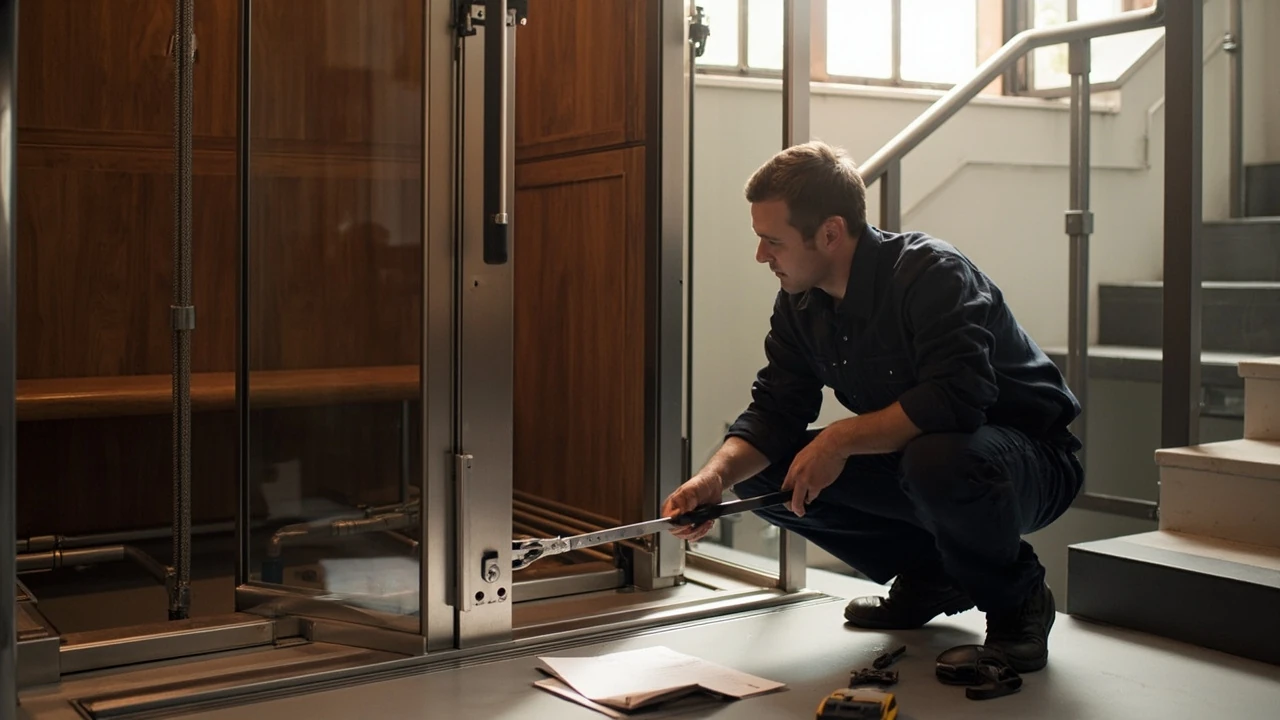
A service visit is a mix of inspection, cleaning, adjustment, and documentation. The list below is what a competent residential elevator maintenance company should do during a standard call. If your technician is doing significantly less, ask why.
- Door system check: interlocks, clutch, rollers, tracks, belt or chain tension, and door restrictor function. The door system accounts for the majority of entrapment calls in residential equipment.
- Drive inspection: sheave or pulley condition, rope or screw wear, oil level and color (hydraulic), controller fault log review, and motor current draw where the controller records it.
- Safety devices: testing the slack rope or slack chain device (traction), the governor, the buffer, the emergency brake, and the pit stop switch. Each safety is a discrete check, not a glance.
- Cab and hoistway cleaning: rails, guide shoes, rollers, sills, and any debris that has collected at the bottom of the pit. Even small amounts of construction dust can affect door sensors.
- Leveling: verifying that the cab stops flush with each landing within the manufacturer’s tolerance, typically within a quarter inch. Drift on leveling is one of the earliest signs of brake or valve wear.
- Controller review: reading fault logs, checking battery condition for the emergency lowering system, and confirming that recall notices or software updates have been applied.
- Documentation: a written report listing what was inspected, what was adjusted, what was deferred, and what should be watched before the next visit.
A good technician will also flag items that are not part of the routine, such as a worn hall button or a slow-closing lobby door, even when the contract does not strictly require it. That kind of judgment is part of what a maintenance contract is paying for.
How often should residential elevator maintenance happen?
Manufacturer recommendations are the floor, not the ceiling, for service frequency. Most major home elevator manufacturers call for two visits per year as a baseline, with quarterly visits on hydraulic units in heavy use, and more frequent attention on pneumatic or screw-driven systems in environments with dust, humidity, or temperature swings. The table below is a starting point; the actual schedule should be set with the installing dealer and reviewed annually.
| Usage profile | Light (under 5 trips/day) | Moderate (5 to 15 trips/day) | Heavy (15+ trips/day or aging in place) |
|---|---|---|---|
| Traction (geared or gearless) | 2 visits per year | 2 to 3 visits per year | 4 visits per year |
| Hydraulic (in-ground) | 2 visits per year | 3 visits per year, oil analysis every 2 years | 4 visits per year, oil analysis annually |
| Hydraulic (holeless) | 2 visits per year | 3 visits per year | 4 visits per year |
| Screw-driven | 2 visits per year, screw inspection annually | 3 visits per year, screw inspection annually | 4 visits per year, screw inspection every 6 months |
| Vacuum / pneumatic | 2 visits per year | 3 visits per year | 4 to 6 visits per year |
Two points are worth underlining. First, usage intensity is not the only driver: a hydraulic system in a coastal climate may need more attention than the same system inland because of corrosion. Second, the schedule should be revisited whenever the household changes, such as adding a wheelchair user, a second resident, or a regular caregiver. The elevator that worked fine for two adults becomes a different system when a power chair is added to the cab on a daily basis.
Warning signs that should trigger a service call between scheduled visits
Some symptoms are noisy, and some are quiet. A useful mental model is to treat anything that changes from a known baseline as a signal. The list below covers the most common residential elevator maintenance triggers in the order they tend to appear as equipment ages.
- New sounds: grinding, squealing, clicking, or a low hum that was not there before. Sounds are often the first sign of a developing mechanical issue and deserve a phone call to the service company even if the elevator is still working.
- Doors that hesitate, reverse, or fail to open. Door problems are the single largest source of entrapments in residential units and usually start as small sensor or roller issues.
- Leveling drift: the cab now sits a half inch above or below the landing instead of flush. Leveling is a brake and valve problem on hydraulic systems, and a brake and encoder problem on traction systems.
- Jerky starts or stops: a sign of motor, valve, or drive component wear, and a safety concern if it gets worse.
- Unresponsive controls: buttons that need multiple presses, indicators that are dim, or a cab phone that does not connect. Electrical and software issues tend to escalate quickly if ignored.
- Moisture or staining in the pit: even small amounts of water at the bottom of the hoistway can corrode safety switches and should be investigated.
A short conversation with the service company is often enough to decide whether the symptom needs a visit now or can wait for the next scheduled one. What matters is that the conversation happens. Small problems in residential elevators are almost always cheaper to address in the first month than in the sixth.
Reading a maintenance contract before you sign it
Maintenance contracts vary widely, and the difference between a thin contract and a thorough one is usually visible in the fine print. The list below is what to look for, in roughly the order it appears in most agreements.
- Scope of routine visits: how many per year, what is included, and what is itemized separately. The phrase “lubricate and adjust” is doing a lot of work if it is the only description.
- Labor coverage: is labor for the routine visit included, and is labor for repairs included, capped, or charged hourly. Many contracts cover only the visit, not the repair work that comes out of it.
- Parts coverage: which parts are included, which are not, and whether common wear items (door rollers, brake pads, seals) are billed separately. Some contracts exclude parts above a dollar threshold without saying so clearly.
- Response time: how quickly the company commits to responding to a call, both during business hours and after. A four-hour commitment is not the same as “we will get there when we can.”
- Callback policy: is the callback free, partially covered, or billed. It is normal to exclude callbacks caused by user behavior (a jammed door, for example) and to include callbacks caused by the work performed.
- Annual test: whether the contract includes any required or recommended annual safety test, and who is responsible for filing paperwork with the authority having jurisdiction.
- Term and renewal: contract length, automatic renewal terms, and how either party can end the agreement. A multi-year contract with a non-trivial cancellation fee deserves a second look.
A practical step is to ask the service company to walk through one of their own contracts line by line on a phone call. The questions a technician can answer comfortably are usually the questions the contract is set up to cover well.
What a homeowner can safely do between visits
Residential elevator maintenance is professional work, and the safety brakes and pit components in particular should not be approached without training. That said, there is a small set of routine tasks that fall within reasonable homeowner responsibility, and keeping up with them reduces the load on the service visit.
- Keep the pit dry. If water appears, identify the source (a sump pump, a foundation leak, condensation) and address it. Persistent moisture corrodes safety switches.
- Wipe the sills and door tracks. A microfiber cloth and a vacuum are enough. Avoid lubricating the tracks unless the manufacturer specifically calls for it; the wrong lubricant attracts grit.
- Listen to the cab. After every ride, take a few seconds to notice whether anything sounds different. A baseline in your own memory is more reliable than you would expect.
- Keep the cab interior clean and uncluttered. Items leaning against door edges are a common cause of entrapments in homes with children or pets.
- Test the cab phone or emergency call device monthly. Place a real test call rather than relying on an indicator light.
- Make sure the machine room or controller closet stays cool and dry. Heat shortens the life of controller boards and contactors.
What a homeowner should not do: attempt to adjust the brakes, bleed the hydraulic valve, or reset a fault that the controller has logged more than once. Those are service-company tasks, and the safety risk of doing them wrong is real.
Costs and what drives them
Residential elevator maintenance contracts in the United States typically run from a few hundred dollars per visit for a basic screw or vacuum unit on a light schedule, to several hundred dollars per visit for a hydraulic or geared traction unit on a quarterly schedule. Annual contract totals commonly land somewhere in the low to mid four figures, depending on the equipment, the region, and what is included. A few structural factors move the price more than anything else:
- Drive type. Hydraulic and traction systems are more expensive to service than screw or pneumatic, mostly because of the labor involved in inspecting cylinders, valves, and motors.
- Region. Urban and coastal areas tend to price higher than rural and inland areas, in line with general service labor costs.
- Age and parts availability. Older equipment with discontinued parts can carry a surcharge because the technician has to source components before the visit.
- Scope. A contract that bundles parts and labor costs more up front than a time-and-materials contract, and the difference can be a reasonable trade for owners who prefer predictable monthly expenses.
The cheapest contract is rarely the best value, and the most expensive is not automatically the most thorough. The most useful comparison is between contracts on similar equipment in the same region, with the scope written out clearly enough to compare line by line.
How to choose a residential elevator maintenance company
The most important variable in residential elevator maintenance quality is the technician, and the second most important is the company behind the technician. The list below is a practical set of filters, in roughly the order they should be applied.
- Manufacturer authorization. Many manufacturers require that a dealer be authorized to perform warranty service on their equipment, and a non-authorized company may not have access to firmware updates or specific parts.
- Distance and response time. A service company an hour away is a different value proposition than one twenty minutes away, especially in an entrapment.
- Local reputation. A short conversation with two or three neighbors who have a similar unit is often more useful than online reviews, which can be sparse for residential work.
- Documentation. Ask for a sample of the post-visit report. A one-line invoice is a warning sign; a checklist-style report is a good sign.
- Continuity. Ask who would actually do the visit and how long they have been with the company. High turnover in service technicians is a common reason quality varies year to year.
For a broader look at the kinds of decisions homeowners face when they own mechanical equipment that needs scheduled service, the maintenance and replacement trade-offs that apply to Furnace Replacement: When Repair Stops Making Sense mirror the same logic: a clear contract, a known service history, and a known timeline before a small problem becomes a system-level one. For a contrasting case, the decision-making around a one-time job such as Attic Fan Installation: Is It Actually Worth It? is much closer to a purchase decision than to a maintenance relationship, and the difference is a useful reminder that an elevator lives on the maintenance side of that line.
Frequently asked questions
How often does a residential elevator need maintenance?
Most home elevators should be serviced at least twice a year under normal use, and quarterly for hydraulic units in heavier use. The exact schedule should be set with the installing dealer and adjusted for climate, usage, and household changes.
What is the average cost of residential elevator maintenance?
Routine maintenance contracts commonly fall in the low to mid four figures per year, depending on the drive type, region, and contract scope. Time-and-materials service is usually cheaper per visit but less predictable over a multi-year horizon.
What happens during a typical maintenance visit?
The technician inspects the door system, drive, safety devices, cab interior, and hoistway, then levels the cab, reviews the controller fault log, and provides a written report. The visit typically lasts an hour or two for a residential unit.
Can a homeowner service their own residential elevator?
Routine cleaning, keeping the pit dry, and testing the emergency call device are reasonable homeowner tasks. Adjusting brakes, bleeding hydraulic valves, or resetting repeated faults should be left to a qualified service company for safety reasons.
What are the most common signs that an elevator needs service?
New sounds, slow or reversing doors, leveling drift, jerky movement, and unresponsive controls are the most common early signs. Any of these symptoms between scheduled visits is a reason to call the service company.
Do residential elevators have to be inspected by the local authority?
Inspection requirements vary by jurisdiction in the United States. Some states and municipalities require annual or triennial inspections of home elevators, and some do not. The maintenance contract and the local building department are the two sources to check for current rules.
What is included in a basic maintenance contract versus a full contract?
A basic contract typically covers scheduled inspections and minor adjustments, with labor and parts for repairs billed separately. A full contract usually bundles labor, common parts, and callbacks for a higher annual fee. The trade-off is between predictable monthly cost and lower per-visit paperwork.
How long does a residential elevator usually last with good maintenance?
With consistent residential elevator maintenance, a well-installed home elevator commonly lasts twenty to thirty years before a major refurbishment is needed. Drive-specific components such as hydraulic seals, cables, and screw assemblies have their own replacement timelines within that range.
Is it safe to keep using an elevator between scheduled service visits if it sounds normal?
Yes, as long as the elevator is functioning normally and the controller is not logging active faults. If anything changes from the established baseline, the right move is to call the service company rather than to wait for the next visit.





Leave a Reply