
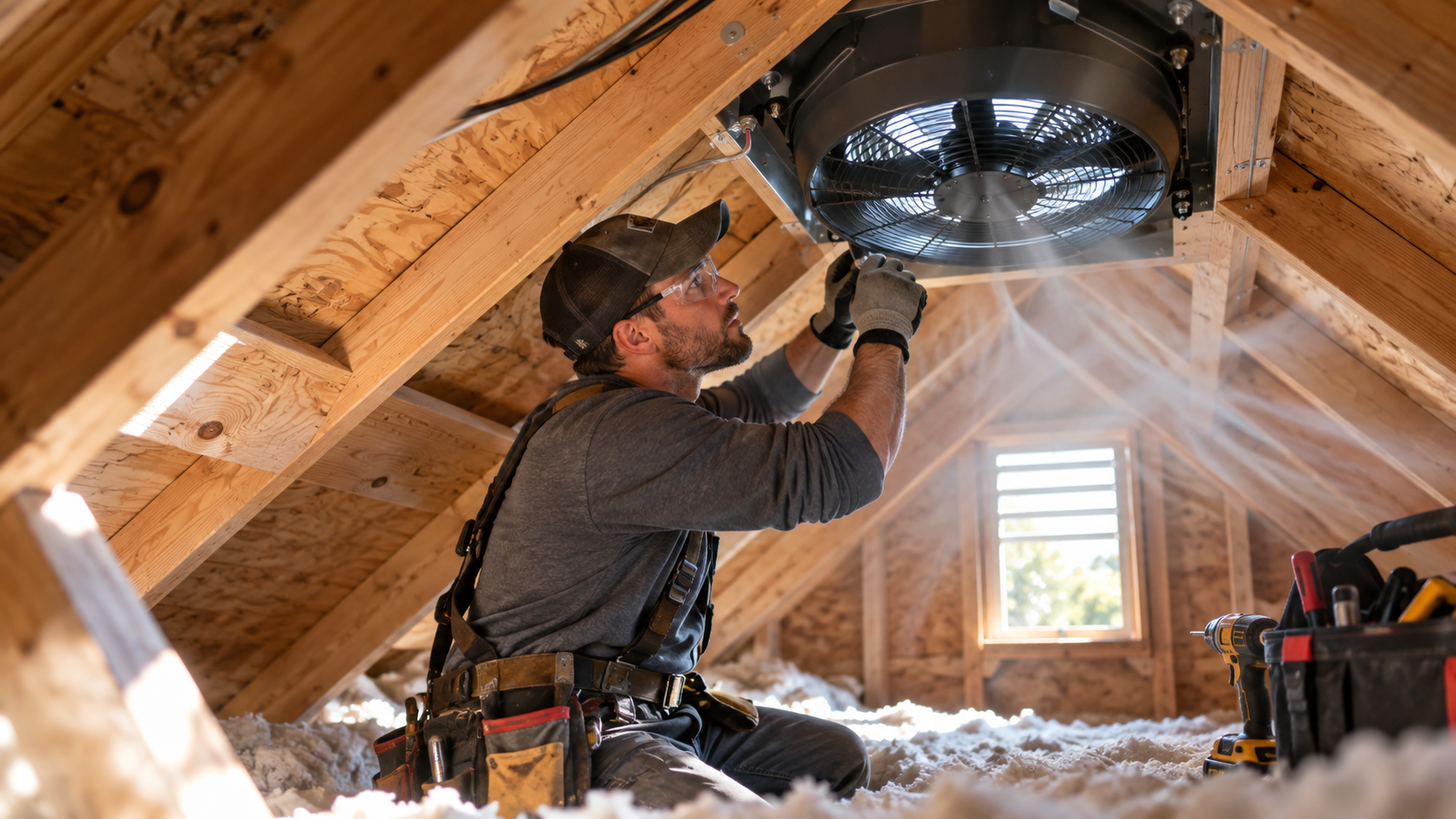
Walk into an attic on a sunny summer afternoon and the first thought is usually pretty simple: this place is unbelievably hot.
So installing a fan feels like an obvious fix.
Pull the hot air out, bring cooler air in, lower the attic temperature, and maybe give the air conditioner an easier job. Makes sense, right?
Sometimes.
But attic fan installation is one of those home projects where the simple explanation leaves out half the story.
An attic is part of a larger system. There is the roof, insulation, ceiling plane, soffit vents, ridge vents, ductwork, air leaks, indoor air pressure, and the heating and cooling equipment below it. Add a powerful exhaust fan without thinking about those pieces and the result may be less impressive than expected.
In some homes, a powered attic fan can help exhaust very hot attic air and support an existing ventilation system. In other homes, it may pull conditioned air from the living space through gaps in the ceiling. That means the air conditioner has to replace air you already paid to cool.
Yep. A fan intended to reduce cooling problems can sometimes create another one.
That does not make attic fans useless. It means installation needs to start with the house rather than the fan.
If you are considering attic fan installation, the important questions are not just how large the fan is or how many cubic feet per minute it can move. You also need to know where replacement air will come from, whether the attic already has enough passive ventilation, whether the ceiling is well air-sealed, and what problem you are actually trying to solve.
First, What Is an Attic Fan?
An attic fan is designed to move air through the attic itself.
Most powered models exhaust attic air outdoors through a roof opening or gable wall. As air leaves, outdoor air should enter through intake vents such as soffit vents.
This is different from a whole-house fan.
A whole-house fan pulls air from the living area into the attic and then outdoors. It is normally used when outdoor temperatures are cooler than indoor temperatures, often during evenings or mornings.
An attic fan, on the other hand, is not supposed to ventilate your bedrooms, kitchen, or living room. Its job is the attic.
Confusing the two can lead to very strange conversations with contractors, so it is worth getting that distinction clear from the start.
| System | Where It Pulls Air From | Main Purpose |
|---|---|---|
| Powered attic fan | The attic | Exhaust hot or humid attic air |
| Whole-house fan | The home’s living space | Cool the house with outdoor air |
| Passive ridge and soffit ventilation | Outdoor air moving through the attic | Provide continuous attic ventilation without a motor |
| Bathroom exhaust fan | Bathroom | Remove moisture and odors from the room |
| HVAC blower | Return-air system inside the home | Circulate conditioned air |
Why Do Attics Get So Hot?
The roof absorbs solar energy.
That heat moves through roofing materials and roof decking, warming the attic below. On a sunny day, especially with a dark roof and little shade, attic temperatures can become much higher than outdoor temperatures.
That does not automatically mean the house has a ventilation failure.
Attics are outside the conditioned envelope in many traditional home designs. They are expected to get hot.
The real question is how much of that heat reaches the living space.
This is where insulation and air sealing become important.
A well-insulated ceiling slows heat transfer. Good air sealing reduces uncontrolled air movement between the attic and rooms below.
If insulation is poor or full of gaps, adding a fan may treat the symptom while leaving the bigger weakness untouched.
What Problem Are You Trying to Fix?
This is probably the best question to ask before buying anything.
Maybe upstairs bedrooms are too warm.
Maybe the attic feels extreme during summer.
Maybe shingles seem unusually hot.
Maybe moisture is collecting on roof sheathing during winter.
Maybe an HVAC contractor mentioned that ductwork in the attic is being exposed to harsh temperatures.
Those are not all the same problem.
An attic fan may be relevant to some of them. Others point toward insulation, duct leakage, air sealing, passive ventilation, moisture control, roofing, or HVAC sizing.
A good contractor should look for the cause instead of treating “hot attic” as a complete diagnosis.
When Attic Fan Installation Can Make Sense
Powered attic ventilation can be useful in certain homes when the attic has adequate intake ventilation and the ceiling below is well sealed.
The fan can help move hot attic air outdoors, especially when natural airflow through the roof is limited.
There are also homes where architecture makes passive ventilation less straightforward. Certain roof shapes, additions, attic sections, or unusual layouts can create stagnant pockets of air.
A carefully planned powered system may help in those situations.
But it should complement a sound attic system, not compensate for major defects elsewhere.
Signs Worth Investigating Before Installing a Fan
- Upper floors remain much warmer than lower floors
- The attic has little or poorly arranged intake ventilation
- Existing passive vents appear blocked
- Air-conditioning ducts in the attic are poorly insulated or leaking
- Insulation levels are low or uneven
- Recessed lights and ceiling penetrations leak air into the attic
- Bathroom fans terminate in the attic instead of outdoors
- Moisture or condensation appears on attic surfaces
- The attic has been modified since the original ventilation system was designed
Notice something?
Most of those conditions are not fixed simply by installing a bigger fan.
The Big Catch: An Attic Fan Has to Get Air From Somewhere
This is where attic fan installation becomes more interesting.
An exhaust fan removes air.
For every bit of air leaving the attic, replacement air has to enter somewhere.
Ideally, it comes through soffit vents or other outdoor intake vents.
If those openings are too small, blocked, or missing, the fan may look for easier sources.
And the ceiling below an attic is rarely perfectly airtight.
There can be gaps around plumbing pipes, wiring penetrations, attic hatches, recessed lights, wall top plates, ducts, and other openings.
A powerful attic fan can create negative pressure in the attic and encourage air to travel through those leaks.
If the home is air-conditioned, that may mean pulling cooled indoor air upward.
The homeowner feels warm upstairs, installs a fan, and then unknowingly sends conditioned air into the attic.
Not ideal.
Air Sealing May Matter More Than the Fan
Before adding powered ventilation, it often makes sense to inspect the attic floor or ceiling plane for leakage.
Some leaks are obvious.
An attic hatch with no weatherstripping is a classic example.
Others are hidden beneath insulation.
Air sealing commonly focuses on penetrations where pipes, electrical wiring, ducts, fixtures, and framing create pathways between conditioned rooms and the attic.
This work can improve comfort during both summer and winter.
That is important because attic fans mainly operate under certain conditions. Air sealing works quietly all year.
Passive Attic Ventilation Should Be Checked First
Many homes use passive ventilation rather than powered fans.
Air enters near the lower edge of the roof, often through soffit vents, and exits higher through ridge, roof, or gable vents.
No motor. No thermostat. No wiring.
The system relies on natural air movement and pressure differences.
When properly designed, passive ventilation has one major advantage: it cannot actively depressurize the attic the way a powered exhaust fan can.
Before installing a powered fan, check whether the passive system is actually functioning.
Soffit vents are sometimes covered by insulation.
Paint can clog older vents.
Storage can block airflow.
A roof replacement may have changed ventilation.
Adding more exhaust without fixing the intake side can make airflow worse rather than better.
How Much Attic Ventilation Is Needed?
Building requirements for attic ventilation vary by location, building design, roof assembly, and code adopted by the local jurisdiction.
Ventilation is generally based on attic floor area and the amount of net free ventilation area provided by the vents.
There are also requirements concerning the distribution of intake and exhaust ventilation.
The important homeowner takeaway is simpler: ventilation has to be balanced.
More exhaust is not automatically better.
A large roof fan with barely any soffit intake is like installing a huge kitchen exhaust hood while keeping every window and door sealed. The air still has to come from somewhere.
If you are changing attic ventilation significantly, ask the contractor to explain how the available intake area compares with the exhaust capacity.
Roof-Mounted vs. Gable-Mounted Attic Fans
Powered attic fans are commonly installed either through the roof or in a gable wall.
Each approach has advantages and tradeoffs.
| Feature | Roof-Mounted Fan | Gable-Mounted Fan |
|---|---|---|
| Location | Installed through roof decking | Mounted in an existing or modified gable opening |
| Roof penetration | Yes | Usually no new roof penetration |
| Visibility | Visible on roof surface | Often less visible from the street |
| Installation access | Requires roof work | Often installed from inside the attic |
| Waterproofing concern | Flashing and roof sealing are critical | Less direct roof-water exposure |
| Best fit | Homes without suitable gable locations | Homes with appropriate gable walls and airflow paths |
Neither style is automatically superior.
The attic shape, roof construction, available intake ventilation, and installation location matter more than the label on the box.
What About Solar Attic Fans?
Solar attic fans are attractive for an obvious reason: the sun creating the attic heat also powers the fan.
They generally avoid the need for a dedicated household electrical connection for normal operation, depending on the product.
That can simplify certain installations.
But solar power does not change the basic airflow rules.
A solar fan still exhausts air.
It still needs adequate intake ventilation.
And if the ceiling is leaky, it can still encourage conditioned air to move into the attic while the fan operates.
So “solar” should not be treated as a shortcut around proper attic design.
Thermostat and Humidistat Controls
Many electric attic fans operate through automatic controls.
A thermostat can turn the fan on when attic temperature rises above a set point and shut it off as the attic cools.
Some systems also use humidity controls.
That can be useful because attic ventilation is not only a summer issue.
Moisture can become a concern during cooler weather, especially when warm indoor air leaks into a cold attic and reaches surfaces where condensation can occur.
But a fan is not a substitute for stopping the moisture source.
If bathroom exhaust is dumping directly into the attic, for example, the answer is not simply to install a stronger attic fan. The bathroom exhaust should be properly directed outdoors.
Attic Fans and Air Conditioning
A common reason homeowners consider attic fan installation is lower air-conditioning use.
The relationship is not as straightforward as marketing sometimes makes it sound.
Lowering attic temperature can reduce heat exposure to ducts and the ceiling below. That sounds helpful.
But if the attic fan draws conditioned air out of the home through ceiling leaks, some of the benefit can disappear.
That is why attic air sealing is such a big deal.
If HVAC ducts run through the attic, their condition also deserves attention.
Leaky duct joints can send conditioned air directly into the attic.
Poorly insulated ducts absorb more heat.
Repairing those problems may produce a more direct improvement than simply moving more attic air.
Attic Fan Installation in Homes With Combustion Appliances
Pressure differences matter whenever a home contains fuel-burning equipment.
A powerful exhaust device can affect airflow through a building.
Depending on where combustion appliances are located and how they obtain combustion air, depressurization can create safety concerns.
This is not a good place for guesswork.
If the house has atmospheric combustion equipment, such as certain older furnaces or water heaters, discuss the planned fan with a qualified contractor who understands building pressure and combustion safety.
Properly installed carbon monoxide alarms remain an important safety layer in homes with fuel-burning appliances.
Can an Attic Fan Fix Upstairs Bedrooms That Feel Too Hot?
Maybe. But do not assume it will.
Hot upstairs rooms can come from several causes.
The attic may be contributing heat through insufficient insulation.
But the HVAC system may also be delivering too little air upstairs.
Return-air paths may be poor.
Ducts may leak.
Windows may receive strong afternoon sun.
The air conditioner itself may be oversized, undersized, or poorly balanced.
If one bedroom is always uncomfortable while the rest of the upper floor is fine, an attic fan is unlikely to be the first thing I would suspect.
That pattern often points toward room-specific airflow or solar-gain problems.
Insulation and Attic Fan Installation
Insulation slows heat transfer between the attic and the living space.
If insulation is thin, compressed, missing in sections, or disturbed around storage areas, heat can move downward more easily.
Before spending money on powered ventilation, have the insulation checked.
Also look for wind washing near soffits, where outdoor air can move through loose insulation and reduce its effectiveness.
Baffles near eaves can help maintain an airflow path from soffit vents while keeping insulation where it belongs.
This is one of those boring attic details that matters far more than it looks.
What Does Attic Fan Installation Involve?
The process depends on whether the fan is roof-mounted, gable-mounted, electric, or solar-powered.
A roof-mounted installation generally requires selecting an appropriate roof location, cutting an opening, mounting the fan assembly, and carefully flashing and sealing the penetration against water intrusion.
A gable-mounted model may attach behind an existing vent or require modifying the gable opening.
Electric fans also need an appropriate electrical supply and control setup.
Roof work and electrical work both bring real safety risks.
This is not a project where improvising with an extension cord and a tube of caulk is a good plan.
What Should a Professional Check Before Installation?
- Existing soffit, ridge, gable, and roof vents
- Available intake ventilation area
- Attic size and layout
- Condition of insulation
- Air leaks through the attic floor
- Bathroom or dryer vents that may terminate improperly
- HVAC ducts located in the attic
- Roof condition and suitable mounting areas
- Electrical access for powered models
- Location of combustion appliances
- Signs of condensation, mold, or roof leakage
- Local permit and building-code requirements
If nobody looks at the soffits or attic floor before recommending a giant exhaust fan, that is worth questioning.
How Much Does Attic Fan Installation Cost?
There is no single useful national price.
The fan itself is only part of the project.
A simple gable installation with easy electrical access can be very different from installing a roof-mounted unit on a steep two-story house.
Roofing material matters.
Electrical access matters.
The attic may be easy to walk through or barely accessible.
A solar-powered system may avoid some wiring work but have a different equipment price.
If additional soffit ventilation, attic air sealing, insulation work, or roof repairs are needed, the total project changes again.
This is why quotes should describe the complete scope rather than only stating “install attic fan.”
What Should Be Included in a Quote?
A written attic fan installation estimate should identify the fan type and model, installation location, electrical work when applicable, roof or gable modifications, flashing or waterproofing work, controls, cleanup, and warranty terms.
If the contractor says additional intake ventilation is necessary, that should be described too.
You should also know whether permits are required in your location and who handles them.
For roof-mounted fans, ask specifically who is responsible for waterproofing the roof penetration and whether that work is covered by the installation warranty.
You really do not want to discover the answer during the first heavy rain.
Will an Attic Fan Make the House Quieter?
No guarantee there.
Fans contain motors and moving blades, so some noise is normal.
Quality equipment, proper mounting, and correct sizing can reduce objectionable noise.
Poorly mounted fans can vibrate against framing or gable walls.
A fan that is much larger than necessary may also move air more aggressively than the attic requires.
If bedrooms are directly below or next to the proposed location, ask about sound before choosing the model.
How Long Do Attic Fans Last?
Service life varies with fan quality, motor design, operating hours, installation quality, climate, roof exposure, and maintenance.
Roof-mounted equipment lives in a fairly harsh environment.
It experiences high temperatures, cold weather, dust, moisture, and constant seasonal temperature swings.
The motor may eventually fail even if the roof housing remains intact.
That is another reason installation access matters.
A system that can be serviced reasonably is much nicer to own than one requiring an expedition every time something needs attention.
Does an Attic Fan Need Maintenance?
Usually not much, but it should not be forgotten forever.
Vents can collect dust and debris.
Screens can become clogged.
Leaves or nests may affect exterior openings.
Motors and bearings may eventually become noisy.
For roof-mounted equipment, the flashing and surrounding roofing should also remain watertight.
If the fan suddenly sounds different, runs continuously, stops operating, or creates vibration, it is worth having it checked.
Do Not Use an Attic Fan to Hide a Moisture Problem
Moisture in an attic deserves investigation.
Condensation on nails, darkened roof sheathing, damp insulation, or musty smells can come from air leakage, roof leaks, bathroom exhaust, inadequate ventilation, or combinations of several issues.
A fan may change moisture levels, but it does not automatically identify or remove the source.
Sometimes the real solution is air sealing.
Sometimes it is roof repair.
Sometimes bathroom ventilation is wrong.
Sometimes insulation is blocking soffit intake vents.
The damp area tells you there is a problem. It does not tell you which product to buy.
Attic Fan Installation vs. Improving Insulation
If the main goal is comfort inside the house, homeowners often face this question.
Which project comes first?
There is no universal answer, but insulation and air sealing directly affect heat transfer between the attic and living space.
A fan changes attic airflow.
That distinction matters.
If the attic floor has major gaps and inadequate insulation, improving the thermal and air barrier may have benefits during both heating and cooling seasons.
A fan may still be appropriate later, but it should not distract from obvious weaknesses in the building envelope.
Common Attic Fan Installation Mistakes
The first mistake is assuming hotter attic air always means a bigger fan is better.
It is not.
The second is ignoring intake ventilation.
The third is installing powered exhaust before sealing major ceiling leaks.
Another mistake is locating a roof fan without thinking carefully about flashing and drainage.
And then there is the classic problem of adding a powered fan to an attic that already has a reasonably balanced passive system without first proving that additional exhaust is necessary.
Home improvement does not always improve when another motor gets added.
How to Compare Attic Fan Contractors
Do not judge the contractor only by the fan brand being offered.
Ask how they determined the fan capacity.
Ask how much intake ventilation the attic has.
Ask whether the ceiling should be air-sealed first.
Ask whether the existing ridge or gable ventilation affects the proposed system.
Ask about wiring.
Ask about roof flashing.
Ask what happens if the motor fails later.
The quality of the explanation tells you a lot.
If the entire recommendation consists of “Your attic is hot, so you need this big fan,” you are missing part of the analysis.
Is DIY Attic Fan Installation a Good Idea?
Some experienced homeowners may be comfortable with portions of attic work, but this project can combine roofing, electrical wiring, ladders, confined attic spaces, and high temperatures.
Roof penetrations deserve particular caution.
A small flashing mistake can create a leak that damages insulation, ceilings, framing, and finishes long after the installation is complete.
Electrical work must also meet applicable requirements.
For many homeowners, professional installation is less about the fan itself and more about avoiding expensive mistakes around it.
What Happens After Installation?
A properly installed attic fan should operate according to its control settings rather than simply running all day and night.
Check the attic after installation.
Listen for unusual vibration.
Look for signs that intake vents remain unobstructed.
For roof-mounted units, watch the area during heavy rain over the following weeks.
Inside the home, pay attention to comfort and HVAC operation.
If rooms suddenly seem harder to cool or you notice unusual pressure effects, the installation deserves another look.
FAQ About Attic Fan Installation
Does an attic fan really cool the house?
An attic fan primarily ventilates the attic rather than directly cooling living rooms. It may reduce attic temperature, but its effect on indoor comfort depends on insulation, air sealing, ductwork, climate, and available intake ventilation.
Can an attic fan make air-conditioning costs higher?
It can in some homes. If the attic lacks enough outdoor-air intake or the ceiling has many air leaks, a powered fan may pull conditioned indoor air into the attic. Proper air sealing and ventilation design are important.
Is a solar attic fan better than an electric fan?
Not automatically. Solar models avoid normal household electricity use while operating from solar power, but they still need proper intake airflow and a well-sealed attic floor. The best option depends on the house and installation location.
Should I install an attic fan if I already have ridge vents?
Not automatically. A functioning ridge-and-soffit ventilation system may already provide the required airflow. Adding powered exhaust can change how air moves through the attic, so the existing system should be evaluated first.
Where should an attic fan be installed?
Powered fans are commonly installed on the roof or in a gable wall. The best location depends on attic shape, intake vents, roof construction, electrical access, and the way existing ventilation is arranged.
Do attic fans help with attic moisture?
Ventilation can be part of moisture control, but moisture often comes from indoor air leakage, bathroom exhaust, roof leaks, or other sources. Those causes should be identified rather than relying on a fan alone.
Should I improve insulation before installing an attic fan?
If attic insulation is inadequate or the ceiling has significant air leakage, improving those conditions may be more important for indoor comfort. A contractor can evaluate insulation, air sealing, and ventilation together before recommending a fan.
Conclusion: Treat the Attic as a System
Attic fan installation sounds like one of the simplest home upgrades.
Hot attic. Add fan.
Problem solved.
But houses rarely cooperate with one-line solutions.
The fan is only one piece of the attic.
There is intake ventilation.
There is insulation.
There is air sealing.
There may be ductwork.
There may be combustion equipment.
There are roof penetrations, moisture sources, and pressure differences between the attic and rooms below.
All of those things affect whether a powered fan helps.
So before buying the biggest unit you can find, start by figuring out why you are considering it.
If upstairs rooms are uncomfortable, inspect insulation, ducts, airflow, windows, and air sealing.
If the attic has moisture, find where that moisture is coming from.
If passive ventilation seems weak, check whether soffit vents are actually open before adding more exhaust.
If the attic already has ridge and soffit ventilation, understand how a powered fan would interact with it.
And if conditioned air can easily leak through the attic floor, deal with that before creating stronger negative pressure above it.
This approach is less exciting than buying a shiny new fan.
But it is much more likely to solve the actual problem.
When a powered attic fan does make sense, proper sizing matters.
More airflow is not automatically better.
The attic needs enough outdoor-air intake to replace what the fan removes.
Otherwise, the fan starts looking elsewhere for air.
That “elsewhere” may be your air-conditioned hallway.
The installation itself deserves just as much attention.
Roof-mounted fans create a new roof penetration, so flashing and waterproofing have to be right.
Gable fans need secure mounting and a sensible airflow path.
Electric models need proper wiring.
Controls should be set appropriately.
And the unit should remain accessible for future service.
If you are comparing estimates, do not compare only fan prices.
Compare the thinking behind the recommendation.
Did the contractor inspect the attic?
Did they look at the soffits?
Did they discuss intake ventilation?
Did they notice insulation problems?
Did they ask about hot rooms or high energy bills?
Did they look for air leaks?
Those questions are more useful than whether one fan moves a few hundred more cubic feet of air per minute than another.
A good attic ventilation plan should also work with the seasons.
Summer heat gets most of the attention because an attic can feel like an oven in July.
But winter moisture matters too.
Warm indoor air leaking into a cold attic can create condensation even when outdoor temperatures are nowhere near summer levels.
That is another reason air sealing belongs in the conversation.
It controls unwanted air movement in both directions and during both heating and cooling seasons.
And remember that a hot attic is not automatically a defective attic.
Unconditioned attics get hot.
The real goal is keeping that heat from becoming a comfort problem inside the home and keeping the roof assembly dry and durable.
Sometimes a powered attic fan contributes to that goal.
Sometimes better insulation does more.
Sometimes air sealing is the missing piece.
Sometimes blocked soffit vents are the entire problem.
And occasionally, the attic ventilation is fine and the uncomfortable bedroom downstairs simply has a bad duct run.
That is why attic fan installation should begin with diagnosis rather than shopping.
Get the airflow right.
Get the insulation right.
Seal the major leaks.
Make sure replacement air has an intentional path into the attic.
Then decide whether powered ventilation adds something useful.
The best attic fan is not the one with the biggest motor or the most impressive product page.
It is the one that fits the house – or, sometimes, the one you discover you did not need at all.





Leave a Reply