
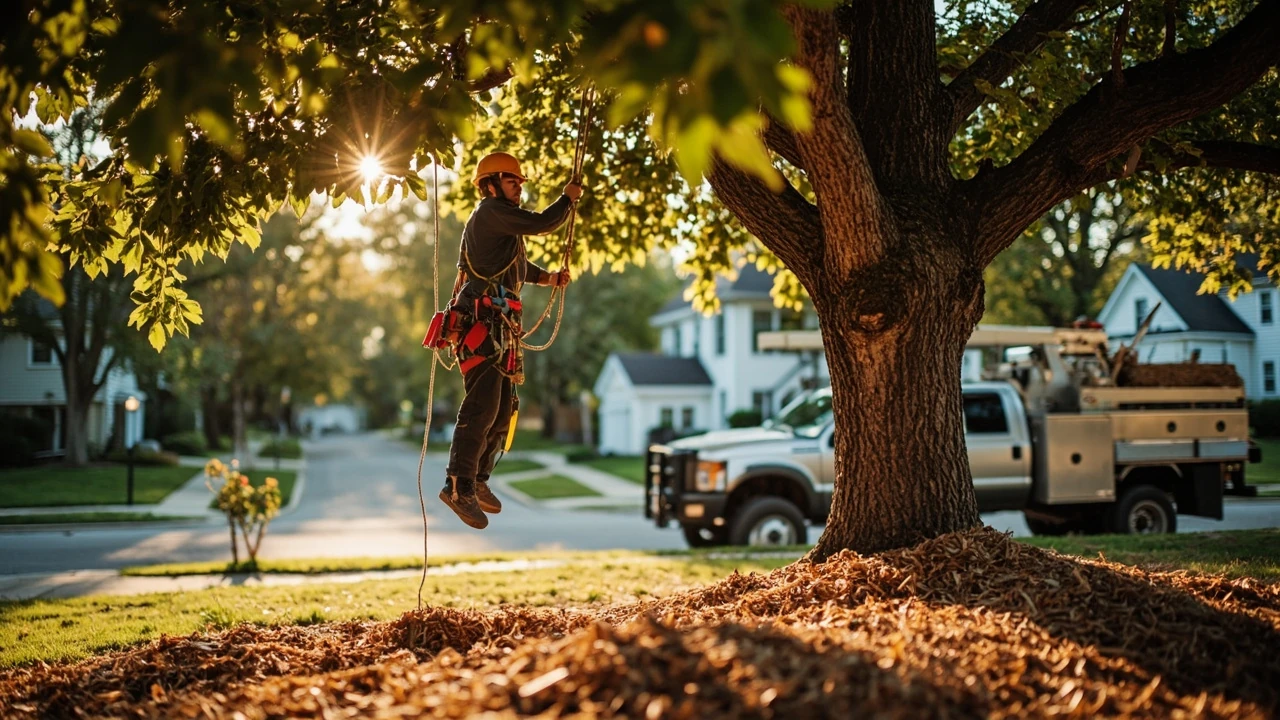
Tree trimming in New Jersey: what homeowners actually need to know
Storms rolling off the Atlantic, wet spring snow loads, summer drought stress, and the steady weight of a New Jersey suburban canopy put real pressure on the trees in your yard. A cracked branch over the driveway, a leaning silver maple after a nor’easter, or a young shade tree that has never been shaped can all lead to the same decision: it is time to arrange proper care. Understanding how tree trimming in New Jersey works, when it is allowed, and who is qualified to do it is the difference between a healthy tree and a costly hazard.
Trimming, often called pruning, is not a single action. It is a set of targeted cuts that remove specific branches for a defined reason: safety, plant health, structural development, or clearance. The state does not regulate every cut a homeowner makes on their own property, but local ordinances, tree protection rules during construction, and utility right-of-way programs shape what can be done, by whom, and when.
Why the timing matters more than most homeowners think
Different species in the Northeast respond to cutting at different times of year. The standard rule from university extension services is to avoid heavy pruning during the active growing season for many shade trees, because open wounds attract insects and disease spores when the tree is pushing sap. Late winter, when the tree is fully dormant, is usually the safest window for structural cuts. Spring-flowering species, however, set their buds the previous year, so trimming them in late winter means losing that season’s bloom. That tradeoff is exactly the kind of decision a qualified arborist weighs before picking up a saw.
When tree trimming becomes a safety issue, not a cosmetic one
Trimming is not only about shape. It is often the first line of defense against storm damage, roof contact, and pedestrian injury. The first reason to cut a branch is rarely appearance.
A clear, defensible reason to schedule tree trimming in New Jersey usually falls into one of four categories:
- Dead, dying, or broken branches that could fall on people, vehicles, or structures.
- Limbs rubbing against the roof, siding, chimney, or service lines, even if the contact seems minor.
- Co-dominant stems, included bark, or other structural defects that make a tree more likely to split.
- Deadwood within the canopy that has become a host for wood-boring insects or cavity-nesting wildlife.
If a branch is already cracked, hanging in the canopy, or scraping shingles in the wind, waiting for a more convenient season is rarely the right call. Emergency trimming, sometimes called hazard reduction, can be done whenever the risk justifies it, even outside the normal pruning window.
What licensed arborists actually do on a trimming visit
Many homeowners expect a trimming crew to arrive with chipper trucks and start cutting. In practice, a professional visit usually starts with a walk-around and a set of decisions made before a single branch is removed.
A typical residential tree trimming visit follows a clear sequence:
- Owner interview: the homeowner describes concerns, recent damage, and any history of storms or construction near the tree.
- Visual inspection: the arborist checks the trunk, root flare, branch unions, and canopy for defects, decay fungi, and old wounds.
- Risk rating: branches and whole trees are classified as low, moderate, or high risk based on target proximity and likelihood of failure.
- Pruning plan: specific cuts are mapped to specific objectives, such as weight reduction, clearance, or structural training.
- Execution: cuts are made to the branch collar, the natural swelling where a branch meets a larger stem, to encourage proper wound closure.
- Debris handling: wood is either chipped on site, hauled away, or left as manageable logs, depending on the contract.
The cost of a visit depends on tree size, accessibility, the amount of material being removed, and whether the crew is climbing with spikes or using an aerial lift. Spiking into a live tree for routine pruning is considered harmful by most professional standards and is usually reserved for removal work.
New Jersey rules that affect when and how you can trim
There is no single statewide residential tree trimming permit for homeowners, but several layers of regulation routinely come into play. Knowing which rule applies can save a fine, a work stoppage, or a neighbor dispute.
Protected species and local tree ordinances
Individual municipalities adopt tree protection ordinances that vary widely. Some towns regulate the removal of trees above a certain trunk diameter measured at breast height, usually 6 to 10 inches, and some require a permit even for significant pruning of trees on public right-of-way. Shade Tree Commissions, where they exist, often review applications for work on street trees. A homeowner who prunes a town-owned tree in the strip between sidewalk and curb without permission can be cited even if the work itself is well done.
Construction and the tree preservation ordinance
When a building permit is pulled, a separate tree removal or tree protection permit is often triggered. Many New Jersey towns follow a model based on the state Department of Agriculture’s recommended tree preservation standards, which limit how much of a protected tree’s canopy can be removed in a single year and require barriers around the critical root zone during construction. Violating these rules can stop a job, and fines for illegal removals can easily exceed the cost of legitimate work.
Utility line clearance
Tree limbs near overhead power lines are a different matter. Utility companies in New Jersey operate under state Public Utility Board oversight and follow pruning cycles and clearance distances set by the board, the New Jersey Board of Public Utilities, and the federal reliability standards that govern the regional grid. Homeowners should never attempt to trim branches within several feet of a primary line. Crews contracted by the utility handle that work, often without a separate request from the property owner, because it is part of their right-of-way maintenance program.
Right-of-way and street trees on private property
The strip of grass between a sidewalk and the curb is usually public land, even though the adjacent homeowner mows it. A tree planted there, or a tree whose trunk crosses the property line, is treated differently from a tree standing fully inside the lot. Tree trimming in New Jersey that touches a street tree, a boundary tree, or a tree under a conservation easement is no longer purely a homeowner decision.
Seasonal timing for the most common New Jersey species
Most residential trees in the state fall into a few broad groups: oaks and other hardwoods, maples, ornamental flowering trees, and evergreens. Each group has its own preferred pruning window. Treating them identically is one of the most common homeowner mistakes.
| Tree group | Common New Jersey examples | Best pruning window | Notes |
|---|---|---|---|
| Native oaks | White, red, pin oak | Late fall through mid-winter | Avoiding the growing season reduces risk of oak wilt spread by sap beetles. |
| Maples and birches | Red maple, silver maple, river birch | Late summer to early fall | Heavy sap bleed in early spring is unsightly but rarely harmful; choose dry weather to limit disease entry. |
| Spring-flowering ornamentals | Dogwood, magnolia, cherry, redbud | Right after spring bloom | Trimming later removes next year’s flower buds. |
| Evergreens and conifers | White pine, spruce, arborvitae | Late winter before new growth | Light shearing is tolerated; avoid cutting back into old wood with no green needles. |
| Storm-damaged trees | Any species | Immediately, regardless of season | Hazard reduction takes priority over horticultural timing. |
Weather windows matter as much as calendar windows. Cold but dry days limit fungal infection of fresh cuts. A hard freeze forecast within 24 hours of pruning is generally a reason to postpone, because freeze damage at the wound margin can set healing back.
How to choose a tree trimming service in New Jersey
The state does not require a license specifically for tree work the way it does for plumbers or electricians, but credentialing still separates casual operators from qualified professionals. The most meaningful credential is a certification from the International Society of Arboriculture, often shown as ISA Certified Arborist. Other useful indicators include membership in the Tree Care Industry Association and the use of ANSI A300 pruning standards, which define how cuts should be made and where they should be placed.
A trustworthy trimming contractor will, before quoting:
- Confirm proof of insurance, including general liability and workers’ compensation, and name the homeowner as a certificate holder.
- Walk the property with the homeowner and point out specific defects, not just general observations.
- Explain which cuts will be made and why, using ordinary language.
- Provide a written estimate that separates labor, equipment, and disposal.
- Discuss whether the work requires a municipal permit and, if so, who pulls it.
Red flags include door-to-door solicitations after a storm, demands for full payment up front, a refusal to show insurance documents, and a quote that is dramatically lower than competing bids. Storm chasing is a recurring problem in the Northeast because homeowners are understandably eager to clear damage quickly, and disreputable operators move in before legitimate contractors can respond.
Tree trimming costs in New Jersey, and what drives them
Pricing varies by region and crew, but the variables are consistent. Understanding them helps a homeowner evaluate any estimate.
| Cost factor | Why it matters | Typical effect on the bill |
|---|---|---|
| Tree size and height | Larger trees require more climbing time, larger equipment, and a bigger crew. | Single small ornamental trees can be trimmed for a few hundred dollars; mature shade trees can run into four figures. |
| Accessibility | Backyard trees with no truck access take longer and may require manual carry-out of debris. | Limited access can add 20 to 40 percent to the labor cost. |
| Number and type of cuts | Cleaning cuts in the canopy are quick; reduction cuts near the trunk take more skill and time. | Detailed structural work on a young tree is often priced per cut or per hour. |
| Equipment used | Aerial lifts, cranes, and chip trucks all carry rental and operator costs. | Specialty equipment can add several hundred to several thousand dollars to a job. |
| Disposal requirements | Hauling logs, stump grinding, and leaving chips for mulch change the price. | Leaving chips on site is usually cheaper than full removal. |
For routine pruning of small ornamental trees, a homeowner in northern or central New Jersey can often expect a few hundred dollars per visit. For a single mature shade tree that needs hazard reduction and crown thinning, a realistic range is often four figures. Always get more than one written estimate for work above a few hundred dollars, and remember that the lowest bid is not always the best value.
How local climate shapes the work
New Jersey sits at the meeting point of several climate zones. The northwest corner sees colder winters and shorter growing seasons than the coastal southeast, and that difference affects both tree growth and the trimming calendar. Coastal counties also deal with salt spray and wind loading, which the inland counties do not face to the same degree. A homeowner on a barrier island and a homeowner in a suburb outside Trenton can be looking at the same species of tree with very different risk profiles.
Atlantic, Ocean, and Monmouth counties, among others, see regular nor’easters that load canopies with wet snow and salt. Cape May and the shore points also see strong prevailing winds that exaggerate defects like co-dominant stems. Inland counties from Morris to Mercer see heavier summer storms with straight-line winds that can shear entire limbs. The trimming plan for a tree on the shore should account for these patterns, and so should a homeowner asking for an estimate, because a crew that prunes for inland conditions may not address coastal failure modes.
For a sense of how varied the state is, it helps to look at a specific community as an example. For additional context, Elizabeth, in Union County, sits along Newark Bay, and its mix of older street trees, dense residential lots, and exposure to coastal weather illustrates how a single municipality can contain very different tree care situations. The pruning plan that fits a young ginkgo in a small front yard there is not the same as the plan for a mature pin oak in a back garden that backs onto a public right-of-way.
What a homeowner can legally do without a professional
Homeowners in New Jersey have wide latitude to maintain trees on their own property, including removing them, subject to local rules. The exception is when a tree is protected by a local ordinance, when a tree is shared with a neighbor, when the work falls under a construction-related tree preservation requirement, or when the tree is within reach of utility lines.
For self-pruning, the practical limits are mostly about safety and the size of the branches involved. A homeowner with sharp hand pruners, loppers, and a stable step ladder can handle the following without a professional:
- Removing suckers at the base of the trunk or along the root flare.
- Cutting small water sprouts from interior branches.
- Pruning shrubs and small ornamental trees within reach of the ground.
- Cleaning up small broken branches after a storm, as long as the ladder work is safe and the cuts are made at the branch collar.
Anything that requires a chainsaw above head height, climbing a tree with a saw, or working within reach of a power line is a job for an insured crew. The risk to the homeowner, in terms of property damage and personal injury, is simply too high.
Common mistakes that shorten the life of a tree
Trimming that is done with the wrong timing, the wrong cuts, or the wrong tools can set a tree back for years. The most common errors are easy to avoid once they are named.
- Topping: cutting a tree back to a uniform height is fast but leaves large wounds and weak regrowth. Most professional arborists refuse to do it.
- Lion’s tailing: stripping the inner canopy to leave foliage only at the tips puts excessive weight on the ends of branches and stresses the tree.
- Flush cuts: cutting a branch flush with the trunk removes the branch collar and slows wound closure.
- Leaving stubs: cutting a branch partway and leaving a stub invites decay to work back into the parent stem.
- Over-thinning: removing too much live canopy at once starves the tree and can trigger sunscald on previously shaded bark.
A reputable service will not propose any of these as a routine solution. If a quote includes heavy reduction by percentage, ask the arborist to point out the specific branches and the specific reason for each cut.
Working with neighbors on shared or boundary trees
New Jersey recognizes a concept of a boundary tree, a tree whose trunk sits on or directly astride the property line. Under longstanding common law, neither owner can remove or severely damage a boundary tree without the other’s consent, and both owners share the cost of routine care, including reasonable trimming. Disputes over boundary trees are a regular source of small-claims court filings in the state, often after a homeowner hires a crew to cut back the neighbor’s side of the canopy without permission.
A practical path is to walk the property with the neighbor, agree on the work that is needed, and split the cost of a shared estimate. The written estimate, the agreed scope, and a clear record of who is doing the work protect everyone involved and reduce the chance of a disagreement later.
What to do after a major storm
After a nor’easter, a tropical system, or a sudden thunderstorm, the priority is safety, not aesthetics. A tree with a cracked leader, a partially uprooted trunk, or a major limb resting on a structure needs attention quickly, and that attention may or may not be the right moment for a full pruning job.
A short post-storm checklist looks like this:
- Stay clear of downed lines and trees that are touching lines; report them to the utility before doing anything else.
- Photograph damage from the ground for insurance purposes, but do not climb on or under the affected tree.
- Call a qualified arborist for an on-site assessment; many offer free storm damage evaluations.
- Decide between emergency stabilization, removal, and full restoration based on the arborist’s risk rating.
- Keep records of the estimate, the work performed, and any communications with insurance.
One storm can be the right moment to schedule a follow-up pruning visit on nearby trees that took wind loading but did not fail. The same crew is often on site, the access equipment is already in place, and a small additional investment can prevent the next failure.
Wildlife, nesting seasons, and the timing of cuts
Trimming and pruning laws do not stop at the lot line. Federal and state rules protect nesting birds, and a tree that is home to an active nest cannot legally be disturbed. The general framework is set by the federal Migratory Bird Treaty Act, which covers most native songbirds, and by New Jersey’s own endangered and nongame species program, which addresses threatened species including several raptors that nest in residential trees.
The active nesting season in New Jersey typically runs from early spring through late summer, with peak activity in May and June. A homeowner planning major tree trimming in New Jersey during those months should ask the arborist to check the canopy for active nests. If a nest is found, the work is usually deferred until the young have fledged, even if the structural risk would otherwise justify immediate action.
How tree trimming fits into a longer care plan
Trimming is one piece of a longer relationship with a tree. A young shade tree benefits from structural pruning every two or three years while it develops its permanent branch architecture. A mature tree can often go four to seven years between visits if the previous work was done well. A neglected tree with multiple defects may need a more intensive restoration over several seasons rather than a single dramatic cleanup.
A useful mental model is to think of a tree the way a homeowner thinks of a roof: regular, modest maintenance is far less expensive than a major repair, and a well-kept tree adds measurable value to a property in a way that a declining tree subtracts it. Most real-estate appraisers and several university extension services have published research indicating that mature, well-maintained trees contribute meaningfully to perceived and actual home value, while damaged or poorly pruned trees reduce curb appeal and can be a flag for buyers during inspection.
Frequently asked questions
Do I need a permit to trim a tree on my own property in New Jersey?
For routine pruning of a tree that stands fully within the property lines, most municipalities do not require a permit, but local rules vary. Trimming a tree in the public right-of-way, removing a tree above a size threshold set by local ordinance, or pruning a tree protected under a tree preservation plan during construction almost always requires a permit. When in doubt, a quick call to the local code enforcement or shade tree commission office confirms the rule.
What is the best time of year to schedule tree trimming in New Jersey?
Late winter through early spring is the most common recommendation for most deciduous shade trees, because the canopy is bare, the structure is easy to see, and the tree is dormant. Spring-flowering ornamentals are an exception and should be trimmed right after they finish blooming, so the next season’s buds are not removed. Hazard reduction after storm damage can be done at any time.
How much does tree trimming cost in New Jersey?
There is no statewide rate, but the most important drivers are tree size, accessibility, the number and type of cuts, and disposal. A small ornamental tree is often a few hundred dollars, while a large mature shade tree with significant work can run four figures. Written estimates from two or three qualified companies give a homeowner a realistic range for the specific trees in question.
How do I know if a tree trimming company is qualified?
The strongest signal is ISA Certified Arborist credentials, which require passing an exam and continuing education. Insurance documentation, a written estimate, and clear explanations of the work being proposed are also markers of a legitimate company. Door-to-door solicitations after a storm, requests for full payment up front, and a refusal to provide proof of insurance are warning signs.
Can my neighbor trim a tree that sits on the property line?
Under New Jersey common law, a boundary tree belongs to both property owners, and neither can remove it or cause serious damage without the other’s consent. Reasonable trimming, with costs often shared, is generally allowed. A tree whose trunk sits entirely on a neighbor’s lot is the neighbor’s responsibility, although the homeowner can usually trim branches that overhang their own property up to the property line, as long as the work does not destabilize the tree.
Is it safe to trim a tree near a power line?
Homeowners should not attempt to trim branches within several feet of an energized primary line. The utility company, or a contractor working for the utility, handles line clearance work under state oversight. Branches near a low-voltage service drop to a house can sometimes be trimmed by a homeowner with care, but the safest path is to call the utility first and ask.
How often should a mature shade tree be trimmed?
A mature tree that has been properly maintained can often go four to seven years between professional visits. Trees with known structural defects, or trees that have been neglected for a long time, may need a more frequent schedule while the canopy is brought back into balance. A standing relationship with a single arborist makes this easier to manage over the life of the tree.
What is the difference between pruning, trimming, and topping?
Pruning and trimming are largely interchangeable terms for the targeted removal of branches for a defined reason. Topping is a specific, widely discouraged practice in which the upper canopy is cut back to a uniform height. Topping leaves large wounds and weak regrowth and is not considered acceptable work by most professional arborists.
Will trimming help a tree that has been damaged in a storm?
Targeted trimming can remove cracked, hanging, or weakened branches and reduce the chance of further failure. A heavily damaged tree may need a combination of trimming, cabling and bracing, or removal, depending on the location of the damage and the tree’s overall condition. An arborist’s on-site assessment is the right way to make that call.
What should I do with the wood and chips after a trimming job?
Most crews will chip smaller branches on site and either haul the chips away or leave them for the homeowner as mulch. Larger logs are sometimes left for firewood, hauled to a commercial facility, or taken by the crew for disposal. The contract should specify the disposal plan before work begins, so there is no disagreement about what stays and what goes.





Leave a Reply